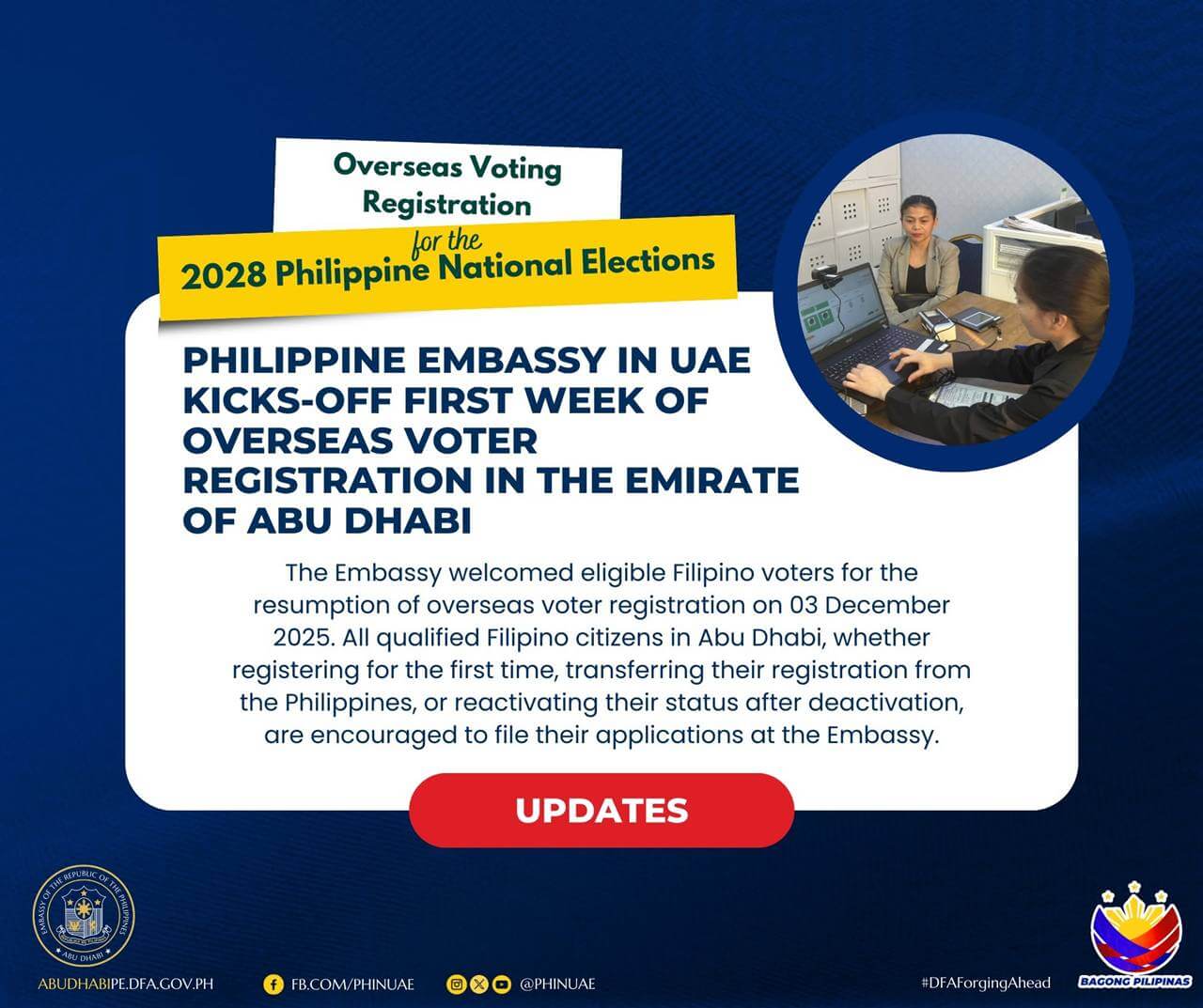
Overseas Voting Registration for Filipinos in Abu Dhabi, UAE

For Filipinos in Abu Dhabi looking to participate in the upcoming Philippines elections 2028, overseas voter registration is an important process to understand. Here’s what you need to know.

In the previous Philippine national elections, 28,523 overseas Filipino residents in Abu Dhabi registered to cast their votes. This number highlights the level of civic participation among Filipinos living in the emirate.

For OFWs based in Dubai and Northern Emirates, please see this overseas registration guide here – Overseas Voting Registration for Filipinos in Dubai and Northern Emirates, UAE

Overseas Voting Registration for Filipinos in Abu Dhabi, UAE

Overseas voting registration in Abu Dhabi for Filipinos is a meticulously organized process, ensuring that every eligible expatriate has the opportunity to participate in the Philippines’ democratic elections. The Resident Election Registration Board (RERB) of the Philippine Embassy in Abu Dhabi plays an important task in this event.

The Philippine Embassy in Abu Dhabi welcomed the first batch of eligible Filipino voter-registrants based in the Emirate of Abu Dhabi on 03 December 2025, marking the resumption of the continuing cycle for Overseas Voter Registration. The registration period will run from 03 December 2025 until 30 September 2027, giving qualified Filipinos across the UAE plenty of time to sign up.

Ambassador Ver encouraged everyone to take part, saying, “As the cycle for continuing registration for overseas voting begins anew, I call on all our kababayan in the UAE who are eligible voters to register and secure their Constitutional right to vote.”

If you’re a Filipino living in the UAE and want to join the list of overseas voters, the process is simple. You can fill out your registration form online at https://irehistro.comelec.gov.ph/ovf1, then appear in person at either the Philippine Embassy in Abu Dhabi or the Philippine Consulate General in Dubai and Northern Emirates to file your application.

Just remember to bring any one of these documents: a valid Philippine Passport, a Seafarer’s Record Book, or a Certified Copy of Approval of Retention or Reacquisition of Philippine Citizenship (for dual citizens). Completing these steps within the registration window secures your spot to vote in the upcoming national elections.

overseas voting registration for filipinos based in abu dhabi uae by philippine embassy uae

Last April 20, 2026, the Second Hearing of the RERB in Abu Dhabi took place on 20 July 2026. During this session, applications for Overseas Voting that were submitted between April to June 2026 were thoroughly reviewed. The board focused on ensuring that all applications met the necessary requirements to secure the transparency and credibility of the registration process.

This quarterly hearing is part of the ongoing commitment to accommodate Filipino voters residing abroad before the registration period ends on 30 September 2027.

Regular assessments by the RERB aim to uphold the integrity of the voting system, enabling Filipinos in the UAE to participate in the democratic process with confidence and ease.

Philippine National Election – May 8, 2028

The 2028 Philippine National Elections will be an important event or Filipino citizens as they vote for key government positions, including the President, Vice President, Senators, and local officials. Both local and overseas Filipino voters will participate in choosing leaders who will govern for the next six years.

Scheduled for May 8, 2028, with overseas voting running from April 9 to May 8, 2028. For Filipinos living abroad, overseas voter registration is open from December 3, 2025, to September 30, 2027.

The Commission on Elections (COMELEC) will oversee the process, ensuring fairness and transparency. Automated voting machines will again be used to improve efficiency and accuracy. As always, voter education, combating misinformation, and promoting clean elections will be top priorities heading into 2028.

Qualifications / Eligibility

  • Be a Filipino citizen
  • Be abroad during the voting period
  • Be at least 18 years old on May 8, 2028
  • Have no disqualifications under Philippine law

Who Are Disqualified?

You may be disqualified if you have:

  • Lost your Filipino citizenship
  • Renounced your Philippine citizenship or pledged allegiance to a foreign country (except dual citizens under RA 9225)
  • Been convicted of an offense punishable by at least one year imprisonment (voting rights can be restored five years after completing your sentence)
  • Been declared insane or incompetent by a competent authority

Requirements

  1. Valid Philippine Passport – Original and photocopy of relevant pages
  2. No Passport? – Obtain a certification from your foreign service post
  3. Seafarers – Include a photocopy of your Seaman’s Book
  4. Dual Citizens – Submit your Dual Citizenship certificate or Order of Approval
  5. Personal Appearance – Required for biometric capture
  6. OVF 1 Form – Download and complete the form from the COMELEC website

    Note: Registered overseas voters with complete biometrics may use the OFOV’s Virtual Frontline Services (VFS). If transferring your registration to a Philippine locality, file your application at the local Office of the Election Officer.

How to Register Online for Overseas Voting

Step 1: Gather the Necessary Documents

  • Valid Philippine passport (Dual Citizens may use Dual Citizenship Documents; Seafarers should have their Seaman’s Book)

Step 2: Fill Out the Application Form

  • Visit the COMELEC website and complete the iRehistro online form.
  • Generate the OVF1 form, which includes a QR code for verification.

Step 3: Submit the Application Form

  • Save and print the OVF1 form on A4-sized paper.
  • Submit the printed form to the nearest Overseas Voting (OV) registration site.

This process, governed by the Philippine Overseas Voting Act (R.A. 9189, amended by R.A. 10590), allows OFWs to vote from abroad. Your vote matters — make sure your voice is heard!

How to Register OFW Voting at the Philippine Embassy in Abu Dhabi

Step 1: Go to the Embassy

Head to the Philippine Embassy in Abu Dhabi at Villa 1, W-48, Street #8, Sector 2-23, Plot 51, P.O. Box 3215, Al Qubaisat, Abu Dhabi.

Step 2: Visit the Registration Counter

Proceed to the designated voter’s registration counter where Embassy staff will assist you.

Step 3: Provide Your Details

Share your personal information with the staff, including your full name, date of birth, and passport details.

Step 4: Verify Your Information

Double-check your details with the staff to ensure everything is accurate and correctly entered into the system.

Step 5: Collect Confirmation

Once registered, you’ll receive a confirmation or receipt. Keep this safe as proof of your registration.

Step 6: Stay Informed

Keep an eye on the Embassy’s official website for any updates or changes to the voter registration process.

Contact Information of the PH Embassy in Abu Dhabi

Address: Villa 1, W-48, Street #8, Sector 2-23, Plot 51 P.O. Box 3215, Al Qubaisat, Abu Dhabi, United Arab Emirates
Contact number: (+971) 50-813-7836
Website: https://abudhabipe.dfa.gov.ph/
Facebook Page: https://www.facebook.com/PHinUAE/
Office Hours:
Monday to Thursday : 7:30 am to 3:30pm
Friday : 7:30 am to 12:00 noon

Google Map Location

Map guide to the PH Embassy in UAE, Abu Dhabi office in Abu Dhabi, UAE:

Overseas Voting Registration: Ensuring Democracy Knows No Boundaries

Voting is a fundamental right and a cornerstone of democracy, allowing citizens to have a say in the governance of their country. Overseas voting allows citizens residing outside their home country to participate in national elections. By registering as an overseas voter, citizens abroad can participate in decisions that impact their nation’s progress and prosperity.

Overseas voting registration is a critical process that ensures citizens residing abroad maintain their ability to participate in national elections. By providing accessible and efficient registration systems, governments uphold the democratic principle of inclusive voter participation regardless of geographic location.

It is the duty of the country’s government to provide a system to ensure fair and accessible voting processes for all citizens, including those residing overseas.

What is Overseas Voting Registration?

Overseas voting registration is how citizens living outside their home country can sign up to vote in their home country’s elections. It lets overseas citizens take part in the political process of their homeland.

To register, citizens typically need to sign up through an online platform or visit a designated location like an embassy or consulate. During registration, you’ll need to provide personal information, proof of citizenship, and other supporting documents.

Why Overseas Voting Registration Matters

Overseas voting registration allows citizens living abroad to:

  • Participate in their home country’s elections
  • Have a say in the leadership and policies of their homeland
  • Stay connected and invested in their country’s future

By allowing overseas citizens to vote, democratic nations ensure that all citizens — regardless of where they live — have a voice.

Eligibility Criteria for Overseas Voting

Eligibility requirements vary by country, but common criteria include:

  • Being a citizen of the country
  • Being at least 18 years old
  • Having a valid passport
  • Meeting any additional residency or citizenship conditions

Overseas Voting Registration Process

The registration process generally involves:

  1. Signing up through an online platform or in person at an embassy, consulate, or designated location
  2. Submitting personal information, proof of citizenship, and supporting documents

Required Documents for Overseas Voting Registration

Documents typically required include:

  • Valid passport
  • Proof of citizenship
  • Proof of residence abroad
  • Any additional documents specific to your country’s requirements

Types of Overseas Voting Registration

Online Registration

Many countries now offer online registration platforms, making it easy to sign up from anywhere in the world. These platforms usually provide step-by-step guidance to help you through the process.

In-Person Registration

For those who prefer face-to-face assistance, many countries offer in-person registration at embassies, consulates, or designated voter registration centers.

Deadlines for Overseas Voting Registration

Countries set deadlines for overseas voting registration well ahead of elections to allow time for ballot preparation and distribution. Make sure you’re aware of these deadlines so you don’t miss your chance to register.

Challenges in Overseas Voting Registration

Overseas voters can face a number of hurdles, including:

  • Language barriers and limited access to information
  • Complex registration processes
  • Logistical issues like postal delays and limited voting locations

Addressing these challenges is key to making sure all eligible citizens can participate, no matter where they are.

Outreach Programs for Overseas Voters

To help overcome these challenges, governments and organizations have launched outreach programs to raise awareness about overseas voting rights, explain the registration process, and guide citizens through it. These programs use campaigns, workshops, and information sharing to help overseas citizens exercise their right to vote.

Voter Education for Overseas Voters

Voter education initiatives help overseas citizens understand why their participation matters, how to register, and when key deadlines are. The more informed overseas voters are, the more likely they are to engage in the democratic process.

Statistics and Trends in Overseas Voting Registration

Tracking the number of registered overseas voters, their demographics, and their election participation helps policymakers understand what’s working and where improvements are needed.

Conclusion

Overseas voting registration ensures that citizens living abroad can still have a say in their home country’s elections. By streamlining registration, tackling challenges, and keeping voters informed, democratic nations can make sure that the right to vote truly has no borders.

Overseas Voting Registration for Filipinos in Tokyo, Japan

Did you know that among the bustling global hubs where overseas Filipino workers exercised their right to vote in the 2022 elections, Tokyo, Japan stood out as a significant player? In a remarkable display of civic engagement, around 550,000 overseas Filipinos from various corners of the world cast their votes. This number places Tokyo alongside other prominent international cities, such as Hong Kong, Singapore, and San Francisco, where the Filipino diaspora made its voice heard in the democratic process, which all started from the overseas voter registration process.

Let’s take a look at the essential details of Overseas Voter Registration for Filipinos in Tokyo, Japan, shedding light on the steps and significance of this unique electoral process.

Overseas Voting Registration for Filipinos in Tokyo, Japan

In accordance with the provisions of Republic Act No. 9189, as amended by Republic Act No. 10590, the Overseas Voter Registration process in Tokyo, Japan plays a crucial role in ensuring that all eligible Filipino citizens living abroad have the opportunity to exercise their democratic rights.

Citizens of the Philippines residing in Tokyo, who meet the age requirement of at least eighteen (18) years old by May 12, 2025, and are registered overseas voters, are eligible to participate in the 2025 Philippine National Elections.

The overseas voting period for this significant event is set to commence on April 13, 2025, and will run until May 12, 2025.

To facilitate the participation of qualified Filipino citizens who are not yet registered as overseas voters, the registration process is made accessible.

They can submit their applications for registration at designated posts abroad, designated registration centers outside the post, or at specified registration centers within the Philippines, as outlined in COMELEC Resolution No. 10833.

This inclusive approach ensures that the overseas voting system in Tokyo, Japan is both accessible and accommodating to all eligible Filipino expatriates.

Philippine (Midterm) Election – May 13, 2025

The May 2025 Philippine Senate election is a pivotal moment in the nation’s democratic journey, marking the 35th iteration of the Senate election.

Scheduled for May 13, 2025 (April 13, 2025, to May 12, 2025, for overseas voters), this election holds immense significance as it will determine the fate of the 12 senators originally elected in 2019.

These senators will play a critical role in shaping the country’s legislative direction until June 30, 2031.

Moreover, they will collaborate with the senators elected in 2022, who will serve until June 30, 2028, forming the Senate’s delegation to the 20th Congress of the Philippines.

This election is part of a broader political landscape, running in conjunction with crucial elections for the House of Representatives and local officials beyond the barangay level.

Overseas voter registration for this historic event took place from December 9, 2022, to September 30, 2024, ensuring the active participation of Filipinos worldwide in shaping the destiny of their nation.

overseas voting registration in philippine elections

Qualifications / Eligibility

  1. Filipino Citizenship:
    • To participate in the May 2025 Philippine Senate Election, you must be a Filipino citizen, either by birth or through naturalization.
  2. Residency Status:
    • You should either currently reside abroad or have plans to be abroad during the 30-day voting period. For the upcoming election, this period is from April 13, 2025, to May 12, 2025.
  3. Age Requirement:
    • You must be at least 18 years old on May 12, 2025, which is the day of the election.
  4. No Disqualifications:
    • You must not be otherwise disqualified by the laws governing voter eligibility in the Philippines.

Also Read: Overseas Voter Registration for Filipinos in Nagoya, Japan

Who Are Disqualified?

Certain conditions may disqualify you from participating in overseas elections. Here are the disqualifications you should be aware of:

  1. Loss of Filipino Citizenship:
    • If you have lost your Filipino citizenship in accordance with Philippine laws, you are disqualified from voting.
  2. Pledged Allegiance to a Foreign Country:
    • Individuals who have expressly renounced their Philippine citizenship or pledged their allegiance to a foreign country, with the exception of dual citizens as defined under Republic Act 9225, are disqualified.
  3. Criminal Conviction:
    • Those who have been convicted by a court or tribunal with a final judgment for an offense punishable by imprisonment of not less than one year are disqualified. However, this disqualification can be removed through plenary pardon or amnesty. If you are disqualified under this subsection, you can regain the right to vote after five (5) years following the completion of your sentence.
  4. Declared Insane or Incompetent:
    • Any citizen of the Philippines residing abroad who has been previously declared insane or incompetent by a competent authority in the Philippines or abroad, as verified by Philippine Embassy, consulates, or Foreign Service establishments concerned, is disqualified. This disqualification can be lifted if the competent authority subsequently certifies that you are no longer insane or incompetent.

By adhering to these qualifications and avoiding the disqualifications mentioned above, you can ensure that your voice is heard in the May 2025 Philippine Senate election.

Your participation will contribute to the democratic process and help shape the future of the Philippines.

Make sure to verify your eligibility and register to vote within the specified time frame to exercise your right to choose your representatives.

overseas voting in tokyo, japan for philippine elections

Requirements

  1. Original and Photocopy of Valid Philippine Passport:
  • Ensure that your Philippine passport is current and valid.
  • Make a photocopy of the relevant pages of your passport for submission.
  1. In the Absence of a Valid Passport:
  • If you do not possess a valid passport, obtain a certification from the foreign service post.
  • This certification should confirm that the foreign service post has reviewed your documents and found them sufficient to warrant a passport issuance. Alternatively, it should state that you are a valid passport holder but cannot produce it for a valid reason.
  1. For Seafarers:
  • If you work as a seafarer, include a photocopy of your Seaman’s Book or any other relevant document that proves your seafaring status. This should be submitted in addition to the passport or certification mentioned in points 1 and 2.
  1. Dual Citizens:
  • If you hold dual citizenship, submit your Dual Citizenship certificate or the Order of Approval (both original and photocopy) along with the documents from points 1 or 2.
  1. Personal Appearance:
  • In most cases, personal appearance is required to capture your biometrics. This step ensures the accuracy and security of the registration process.
  1. Duly Filled Out OVF 1 Form:
  • Complete the Overseas Voting Form 1 (OVF 1). You can find the form on the Commission on Elections (COMELEC) website.

Additional Note:

  • Registered overseas voters with complete biometric data may also utilize the Office for Overseas Voting’s (OFOV) Virtual Frontline Services (VFS) for certain types of applications.

Transfer of Registration:

  • If you need to transfer your registration from your overseas post to a Philippine Municipality, City, or District, you should file your application at the local Office of the Election Officer in the area where you intend to vote in the Philippines. Be sure to adhere to the rules and regulations governing local voter registration for this process.

By following these requirements and guidelines, you can ensure that your overseas voter registration is complete and accurate, allowing you to participate in the upcoming elections and make your voice heard in the democratic process.

How to Register Online for Overseas Voting

Step 1: Gather the Necessary Documents

  • Ensure you have a valid Philippine passport.
  • If you are a dual citizen, Dual Citizenship Documents are acceptable.
  • Seafarers should have their Seaman’s Book ready.

Step 2: Fill Out the Application Form

  • Visit the Commission on Elections (COMELEC) website, which provides an online application form called iRehistro for Overseas Voters Version 5.0.6.1.
  • Use this platform to accurately fill out the required information.
  • Generate the OVF1 form, which will include a QR code for verification.

Step 3: Submit the Application Form

  • After encoding all the necessary details and generating the OVF1 form, save it as a PDF file on your device.
  • Print the PDF on an A4-sized sheet of paper. This printout serves as your OVF1 form.
  • Personally submit the printed OVF1 form to the nearest Overseas Voting (OV) registration site. This is a critical step in processing your voter registration application.

It’s important to note that this registration process is mandated by the Philippine Overseas Voting Act, overseen by the Office for Overseas Voting (OFOV), and governed by R.A. 9189 (amended by R.A. 10590).

As an overseas Filipino worker (OFW), this process allows you to cast your vote from your host country, ensuring that your voice is heard in your homeland’s democratic elections.

Your participation matters, and this guide makes it easier for you to register and contribute to the democratic process of the Philippines.

Ensure you follow these steps carefully to successfully register as an overseas voter and exercise your right to vote in Philippine elections.

Also read: Overseas Voter Registration for Filipinos in Osaka, Japan

How to Register at the Philippine Embassy in Tokyo

Step 1: Gather Required Documents

Before you begin the registration process, ensure you have the necessary documents:

  • Valid Philippine Passport: This is the primary identification document. If you have a valid Philippine passport, it should be presented during registration.
  • In the absence of a valid Passport, provide one of the following:
    • A certification issued by the Philippine Embassy/Consulate General stating that they have received and reviewed your documents and found them sufficient for passport issuance, or that you hold a valid passport but cannot produce it for a valid reason.
    • For applicants who reacquired Filipino Citizenship under Republic Act No. 9225, you’ll need the original or certified true copy of the Order of Approval of your application to retain or reacquire Filipino citizenship issued by the Philippine Embassy/Consulate or your Identification Certificates issued by the Philippine Embassy/Consulate or the Bureau of Immigration.
    • Seafarers should provide a photocopy of their Seafarer’s Book.

Step 2: Complete the Overseas Voter Registration Form (OVF1)

  • Obtain an Overseas Voter Registration Form (OVF1) from the designated registration center or online. Fill out the form accurately and completely.

Step 3: Schedule an Appointment

  • If you are registering at the Philippine Embassy in Tokyo, you may need to schedule an appointment for Overseas Voter registration. This can be done using the provided QR code or by visiting: https://tokyopeconsularappointment.setmore.com/.

Step 4: Submit Your Application

  • Personally submit your Overseas Voter Registration Form (OVF1) along with the required documents to the designated registration center. Ensure that all your documents are in order and your form is correctly filled out.

Step 5: Registration Period

  • Keep in mind that the registration period for the May 2025 Philippine Senate Election is from December 9, 2022, to September 30, 2024. Make sure to register within this timeframe to be eligible to vote.

Step 6: Verification

  • After submitting your application, the authorities will review your documents and information to confirm your eligibility for overseas voting.

Step 7: Await Confirmation

  • Once your application is processed and verified, you will receive confirmation of your registration as an overseas voter.

Contact Information

Philippine Embassy in Japan (Tokyo)
Address: 5-15-5 Roppongi Minato-ku, Tokyo 106-8537
Contact number: (03) 5562-1600 If you know the extension number of the person you are calling, at the voice prompt dial 8 + the local number + # + 0
Website: https://tokyo.philembassy.net/
Facebook Page: https://www.facebook.com/PHLinJapan 
Office Hours: 0900H to 1800H Monday to Friday

Google Map Location

Overseas Voter Registration for Filipinos in Nagoya, Japan

Did you know that OFWs living in Nagoya, Japan, have a unique opportunity to actively participate in their homeland’s electoral process starting with overseas voter registration? The Resident Election Registration Board (RERB) of the Philippine Consulate General Nagoya convened on July 17, 2023, to hear the applications for registration, certification, correction of entries, and more, which had been filed with the Post between April 1, 2023, and June 30, 2023.

This is key to ensuring that overseas Filipino citizens in Nagoya maintain their voice in the Philippines’ democratic journey. In line with this, let’s take a look at the overseas voter registration process for Filipinos residing in Nagoya, Japan, and its significance in fostering civic engagement among Filipinos on that side of the globe.

Overseas Voter Registration for Filipinos in Nagoya, Japan

In preparation for the upcoming Philippine national elections, the Philippine Consulate General (PCG) in Nagoya, Japan, has been actively engaging with the Filipino community.

One significant event in this regard was the Consular Outreach Mission recently held on September 17, 2023, in Hamamatsu, Shizuoka.

This outreach mission, spearheaded by Consul General Roy Ecraela, marked a milestone as it was the first of its kind conducted by the Nagoya PCG since its establishment in 2019.

The event was held at the Hamamatsu Foundation for International Communication and Exchange (HICE), which generously provided the venue free of charge.

During this day-long outreach, the dedicated team, led by DCG Jerome Castro, efficiently processed 138 passports and 75 civil registration and notarial applications, ensuring that Filipinos in the region had the necessary documents to participate in the upcoming elections.

Furthermore, the Overseas Voting division, under the guidance of Consul Fernando Beup, processed 60 Overseas Voting registrations, emphasizing the PCG’s commitment to facilitating the participation of Filipinos residing there in the democratic process.

As the PCG in Nagoya, Japan, continues to actively engage with its community, events like the Consular Outreach Mission play a crucial role in ensuring that overseas Filipinos are well-prepared and empowered to exercise their right to vote in the upcoming Philippine national elections.

Also Read: Overseas Voting Registration for Filipinos in Tokyo, Japan

Philippine (Midterm) Election – May 13, 2025

The May 2025 Philippine Senate election holds a crucial place in the nation’s democratic journey, marking its 35th occurrence.

It’s scheduled for May 13, 2025 (or from April 13, 2025, to May 12, 2025, for overseas voters), and its importance lies in determining the future of the 12 senators originally elected in 2019.

These senators will play a vital role in shaping the country’s laws and policies until June 30, 2031.

Additionally, they will work alongside the senators elected in 2022, who will serve until June 30, 2028, together forming the Senate’s delegation to the 20th Congress of the Philippines.

This election is part of a broader political landscape, happening simultaneously with significant elections for the House of Representatives and local officials above the barangay level.

The overseas voter registration, held from December 9, 2022 to September 30, 2024, ensures that Filipinos worldwide can actively participate in determining the future of the homeland.

Also Read: Overseas Voter Registration for Filipinos in Osaka, Japan

overseas voting registration in philippine elections

Qualifications / Eligibility

  1. Filipino Citizenship:
  • To vote in the May 2025 Philippine Senate Election, you must be a Filipino citizen. You can attain citizenship either by birth or through naturalization.
  1. Residency Status:
  • You should either currently reside abroad or have plans to be abroad during the 30-day voting period. For the upcoming election, this period is from April 13, 2025, to May 12, 2025.
  1. Age Requirement:
  • You must be at least 18 years old on May 12, 2025, which is the day of the election.
  1. No Disqualifications:
  • Ensure you are not otherwise disqualified by the laws governing voter eligibility in the Philippines.

Who Are Disqualified?

Certain conditions may disqualify you from participating in overseas elections. Here are the disqualifications you should be aware of:

  1. Loss of Filipino Citizenship:
  • If you have lost your Filipino citizenship in accordance with Philippine laws, you are disqualified from voting.
  1. Pledged Allegiance to a Foreign Country:
  • Individuals who have expressly renounced their Philippine citizenship or pledged their allegiance to a foreign country, with the exception of dual citizens as defined under Republic Act 9225, are disqualified.
  1. Criminal Conviction:
  • Those who have been convicted by a court or tribunal with a final judgment for an offense punishable by imprisonment of not less than one year are disqualified.
  • However, this disqualification can be removed through plenary pardon or amnesty.
  • If you are disqualified under this subsection, you can regain the right to vote after five (5) years following the completion of your sentence.
  1. Declared Insane or Incompetent:
  • Any citizen of the Philippines residing abroad who has been previously declared insane or incompetent by a competent authority in the Philippines or abroad, as verified by the Philippine Embassy, consulates, or Foreign Service establishments concerned, is disqualified.
  • This disqualification can be lifted if the competent authority subsequently certifies that you are no longer insane or incompetent.

By adhering to these qualifications and avoiding the disqualifications mentioned above, you can ensure that your voice is heard in the May 2025 Philippine Senate election.

Your participation will contribute to the democratic process and help shape the future of the Philippines.

Make sure to verify your eligibility and register to vote within the specified time frame to exercise your right to choose your representatives. Your vote matters!

overseas voting in japan for philippine elections

Requirements

  1. Original and Photocopy of Valid Philippine Passport:
    • Ensure your Philippine passport is current and valid.
    • Make a photocopy of relevant passport pages for submission.
  2. In the Absence of a Valid Passport:
    • If you lack a valid passport, obtain a certification from the foreign service post.
    • This certification should confirm that your documents have been reviewed and are sufficient for passport issuance or state the valid reason for not having a passport.
  3. For Seafarers:
    • If you work as a seafarer, include a photocopy of your Seaman’s Book or relevant document proving your seafaring status. This should be submitted along with the passport or certification from points 1 and 2.
  4. Dual Citizens:
    • If you hold dual citizenship, submit your Dual Citizenship certificate or the Order of Approval (both original and photocopy) along with the documents from points 1 or 2.
  5. Personal Appearance:
    • In most cases, personal appearance is required to capture your biometrics. This step ensures the accuracy and security of the registration process.
  6. Duly Filled Out OVF 1 Form:
    • Complete the Overseas Voting Form 1 (OVF 1), available on the Commission on Elections (COMELEC) website.

Additional Note:

  • Registered overseas voters with complete biometric data may also utilize the Office for Overseas Voting’s (OFOV) Virtual Frontline Services (VFS) for certain types of applications.

Transfer of Registration:

  • If you need to transfer your registration from your overseas post to a Philippine Municipality, City, or District, file your application at the local Office of the Election Officer in the area where you intend to vote in the Philippines. Ensure compliance with rules and regulations governing local voter registration for this process.

By adhering to these requirements and guidelines, you can complete your overseas voter registration accurately and participate in upcoming elections, making your voice heard in the democratic process. Your vote matters, even from abroad!

How to Register Online for Overseas Voting

Step 1: Gather the Necessary Documents

  • Ensure you have a valid Philippine passport.
  • If you are a dual citizen, Dual Citizenship Documents are acceptable.
  • Seafarers should have their Seaman’s Book ready.

Step 2: Fill Out the Application Form

  • Visit the Commission on Elections (COMELEC) website, which provides an online application form called iRehistro for Overseas Voters Version 5.0.6.1.
  • Use this platform to accurately fill out the required information.
  • Generate the OVF1 form, which will include a QR code for verification.

Step 3: Submit the Application Form

  • After encoding all the necessary details and generating the OVF1 form, save it as a PDF file on your device.
  • Print the PDF on an A4-sized sheet of paper. This printout serves as your OVF1 form.
  • Personally submit the printed OVF1 form to the nearest Overseas Voting (OV) registration site. This is a critical step in processing your voter registration application.

It’s essential to note that this registration process is mandated by the Philippine Overseas Voting Act, overseen by the Office for Overseas Voting (OFOV), and governed by R.A. 9189 (amended by R.A. 10590).

As an OFW or dual citizen, this process allows you to cast your vote from your host country, ensuring that your voice is heard in your homeland’s democratic elections.

Your participation matters, and this guide makes it easier for you to register and contribute to the democratic process of the Philippines.

Ensure you follow these steps carefully to successfully register as an overseas voter and exercise your right to vote in Philippine elections. Your vote can make a significant impact on the future of your country.

How to Register at the Philippine Consulate General in Nagoya

Step 1: Gather Required Documents

Before beginning the registration process, ensure you have the necessary documents:

  • Valid Philippine Passport: This is your primary identification document. If you possess a valid Philippine passport, you should present it during registration.
  • In the absence of a valid Passport, provide one of the following:
    • A certification issued by the Philippine Embassy/Consulate General stating that they have received and reviewed your documents and found them sufficient for passport issuance, or that you hold a valid passport but cannot produce it for a valid reason.
    • For applicants who reacquired Filipino Citizenship under Republic Act No. 9225, you’ll need the original or certified true copy of the Order of Approval of your application to retain or reacquire Filipino citizenship issued by the Philippine Embassy/Consulate or your Identification Certificates issued by the Philippine Embassy/Consulate or the Bureau of Immigration.
    • Seafarers should provide a photocopy of their Seafarer’s Book.

Step 2: Complete the Overseas Voter Registration Form (OVF1)

  • Obtain an Overseas Voter Registration Form (OVF1) from the designated registration center or online. Fill out the form accurately and completely.

Step 3: Schedule an Appointment

  • If you are registering at the Philippine Consulate General in Nagoya, you need to schedule an appointment for Overseas Voter registration via email at votersreg.nagoyapcg@gmail.com.

Step 4: Submit Your Application

  • Personally submit your Overseas Voter Registration Form (OVF1) along with the required documents to the designated registration center. Ensure that all your documents are in order and your form is correctly filled out.

Step 5: Registration Period

  • Keep in mind that the registration period for the May 2025 Philippine Senate Election is from December 9, 2022, to September 30, 2024. Make sure to register within this timeframe to be eligible to vote.

Step 6: Verification

  • After submitting your application, the authorities will review your documents and information to confirm your eligibility for overseas voting.

Step 7: Await Confirmation

  • Once your application is processed and verified, you will receive confirmation of your registration as an overseas voter.

Contact Information

Philippine Consulate General in Nagoya, Japan
Address: Hiroya Building, 3-31-3 Sakae, Naka-ku Nagoya-shi, Aichi-ken Japan 460-0008
Contact number: +81(0) 52-211-8811
Office hours: 9:00AM to 6:00PM
Website: https://nagoyapcg.dfa.gov.ph/
Facebook Page: https://www.facebook.com/PHinNagoya

Google Map Location

Overseas Voter Registration for Filipinos in Osaka, Japan

Did you know that among the 162 different nationalities represented in the diverse foreigner population of Osaka prefecture, there are seven countries that collectively make up nearly 90% of the total? Among these nations, the Philippines stands out as a significant contributor, representing 3.4% of the foreign community. This remarkable statistic highlights the presence of a vibrant overseas Filipino community in Japan and the significance of overseas voter registration, particularly in areas like Osaka.

With this in mind, let us delve into the crucial topic of Overseas Voter Registration for Filipinos in Osaka, Japan, shedding light on the importance of this process and its impact on the Filipino diaspora’s engagement in their homeland’s democratic processes. Let’s begin!

Overseas Voter Registration for Filipinos in Osaka, Japan

In anticipation of the forthcoming national elections, the Philippine Consulate General in Osaka has been actively engaging with the Filipino community in Japan.

A significant recent development was the convening of the Resident Election Registration Board (RERB) on 17 July 2023, held at the prestigious Twin 21 MID Tower in Osaka.

This event served as a crucial step in the preparation for the next national elections and provided an opportunity for Filipinos residing in Osaka to register as overseas voters.

The PCG’s commitment to ensuring the participation of Filipinos in the democratic processes of their homeland was evident in the meticulous planning and execution of this event, emphasizing the importance of civic engagement and the rights of overseas Filipinos to have a voice in shaping the future of their country.

Philippine (Midterm) Election – May 13, 2025

The upcoming May 2025 Philippine Senate election is a significant milestone in the nation’s democratic journey, marking the 35th iteration of this crucial event.

Set to take place on May 13, 2025 (with a window for overseas voters from April 13, 2025, to May 12, 2025), this election holds immense importance as it will determine the fate of the 12 senators originally elected in 2019.

These senators will wield substantial influence in shaping the country’s legislative course until June 30, 2031.

Their collaboration with the senators elected in 2022, who will serve until June 30, 2028, will form the core of the Senate’s representation in the 20th Congress of the Philippines.

This election is part of a broader political landscape, running concurrently with critical elections for the House of Representatives and local officials beyond the barangay level.

Overseas voter registration for this historic event spanned from December 9, 2022, to September 30, 2024, ensuring the active participation of Filipinos worldwide in influencing the destiny of their beloved nation.

Also Read: Overseas Voter Registration for Filipinos in Nagoya, Japan

Qualifications / Eligibility

  1. Filipino Citizenship:
    • To participate in the May 2025 Philippine Senate Election, you must be a Filipino citizen, either by birth or through naturalization.
  2. Residency Status:
    • You should either currently reside abroad or have plans to be abroad during the 30-day voting period. For the upcoming election, this period is from April 13, 2025, to May 12, 2025.
  3. Age Requirement:
    • You must be at least 18 years old on May 12, 2025, which is the day of the election.
  4. No Disqualifications:
    • You must not be otherwise disqualified by the laws governing voter eligibility in the Philippines.

Who Are Disqualified?

Certain conditions may disqualify you from participating in overseas elections. Here are the disqualifications you should be aware of:

  1. Loss of Filipino Citizenship:
    • If you have lost your Filipino citizenship in accordance with Philippine laws, you are disqualified from voting.
  2. Pledged Allegiance to a Foreign Country:
    • Individuals who have expressly renounced their Philippine citizenship or pledged their allegiance to a foreign country, with the exception of dual citizens as defined under Republic Act 9225, are disqualified.
  3. Criminal Conviction:
    • Those who have been convicted by a court or tribunal with a final judgment for an offense punishable by imprisonment of not less than one year are disqualified. However, this disqualification can be removed through plenary pardon or amnesty. If you are disqualified under this subsection, you can regain the right to vote after five (5) years following the completion of your sentence.
  4. Declared Insane or Incompetent:
    • Any citizen of the Philippines residing abroad who has been previously declared insane or incompetent by a competent authority in the Philippines or abroad, as verified by Philippine Embassy, consulates, or Foreign Service establishments concerned, is disqualified. This disqualification can be lifted if the competent authority subsequently certifies that you are no longer insane or incompetent.

By adhering to these qualifications and avoiding the disqualifications mentioned above, you can ensure that your voice is heard in the May 2025 Philippine Senate election.

Your participation will contribute to the democratic process and help shape the future of the Philippines.

Make sure to verify your eligibility and register to vote within the specified time frame to exercise your right to choose your representatives.

overseas voting registration in philippine elections

Requirements

  1. Original and Photocopy of Valid Philippine Passport:
    • Ensure that your Philippine passport is current and valid.
    • Make a photocopy of the relevant pages of your passport for submission.
  2. In the Absence of a Valid Passport:
    • If you do not possess a valid passport, obtain a certification from the foreign service post.
    • This certification should confirm that the foreign service post has reviewed your documents and found them sufficient to warrant a passport issuance.
    • Alternatively, it should state that you are a valid passport holder but cannot produce it for a valid reason.
  3. For Seafarers:
    • If you work as a seafarer, include a photocopy of your Seaman’s Book or any other relevant document that proves your seafaring status. This should be submitted in addition to the passport or certification mentioned in points 1 and 2.
  4. Dual Citizens:
    • If you hold dual citizenship, submit your Dual Citizenship certificate or the Order of Approval (both original and photocopy) along with the documents from points 1 or 2.
  5. Personal Appearance:
    • In most cases, personal appearance is required to capture your biometrics. This step ensures the accuracy and security of the registration process.
  6. Duly Filled Out OVF 1 Form:
    • Complete the Overseas Voting Form 1 (OVF 1). You can find the form on the Commission on Elections (COMELEC) website.

Additional Note:

  • Registered overseas voters with complete biometric data may also utilize the Office for Overseas Voting’s (OFOV) Virtual Frontline Services (VFS) for certain types of applications.

Transfer of Registration:

  • If you need to transfer your registration from your overseas post to a Philippine Municipality, City, or District, you should file your application at the local Office of the Election Officer in the area where you intend to vote in the Philippines. Be sure to adhere to the rules and regulations governing local voter registration for this process.

By following these requirements and guidelines, you can ensure that your overseas voter registration is complete and accurate, allowing you to participate in the upcoming elections and make your voice heard in the democratic process. Your active participation is vital in shaping the future of the Philippines.

overseas voting in dubai for philippine elections

How to Register Online for Overseas Voting

Step 1: Gather the Necessary Documents Before you begin the online registration process for overseas voting, make sure you have the following documents ready:

  • Valid Philippine Passport: Ensure that your Philippine passport is up-to-date and valid.
  • Dual Citizenship Documents (if applicable): If you are a dual citizen, have your dual citizenship documents prepared.
  • Seaman’s Book (for Seafarers): Seafarers should have their Seaman’s Book ready for the registration process.

Step 2: Fill Out the Application Form Follow these steps to fill out the online application form for overseas voting:

  1. Visit the Commission on Elections (COMELEC) website. They provide an online application form called iRehistro for Overseas Voters Version 5.0.6.1.
  2. On the website, accurately complete the required information as prompted. Ensure that all details are correct, as this information will be used for your voter registration.
  3. After successfully filling out the form, the system will generate the OVF1 form. This form includes a QR code for verification purposes.

Step 3: Submit the Application Form Once you have generated the OVF1 form, follow these steps to submit your application:

  1. Save the OVF1 form as a PDF file on your device for printing.
  2. Print the OVF1 form on an A4-sized sheet of paper. This printout serves as your official OVF1 form.
  3. Personally submit the printed OVF1 form to the nearest Overseas Voting (OV) registration site. This step is crucial to process your voter registration application.

Important Information: This registration process is mandated by the Philippine Overseas Voting Act, overseen by the Office for Overseas Voting (OFOV), and governed by R.A. 9189 (amended by R.A. 10590).

As an overseas Filipino worker (OFW), this process allows you to cast your vote from your host country, ensuring that your voice is heard in your homeland’s democratic elections.

Also Read: Overseas Voting Registration for Filipinos in Tokyo, Japan

How to Register at the Philippine Embassy in Osaka

Step 1: Gather Required Documents

Before embarking on the overseas voter registration process, ensure that you have the necessary documents in hand. These include:

  • Valid Philippine Passport: Your valid Philippine passport is the primary identification document required for registration. Make sure it is up-to-date and readily available during the registration process.
  • Alternative Documents: In case you do not possess a valid passport, you can provide one of the following alternative documents:
    • A certification issued by the Philippine Embassy/Consulate General confirming the reception and review of your documents, which are found sufficient for passport issuance. Alternatively, this certification can state that you possess a valid passport but cannot produce it for a valid reason.
    • For individuals who have reacquired Filipino Citizenship under Republic Act No. 9225, you will need the original or certified true copy of the Order of Approval of your application to retain or reacquire Filipino citizenship issued by the Philippine Embassy/Consulate or your Identification Certificates issued by the Philippine Embassy/Consulate or the Bureau of Immigration.
    • Seafarers should provide a photocopy of their Seafarer’s Book.

Step 2: Complete the Overseas Voter Registration Form (OVF1)

Proceed to obtain an Overseas Voter Registration Form (OVF1) either from the designated registration center or online. Ensure that you fill out the form accurately and completely.

Step 3: Schedule an Appointment

If you intend to register at the Philippine Consulate General in Osaka, you may need to schedule an appointment for Overseas Voter registration. This can be conveniently done by visiting the official appointment scheduling website here.

Step 4: Submit Your Application

It’s time to personally submit your completed Overseas Voter Registration Form (OVF1) along with the required documents to the designated registration center. Before submission, double-check that all your documents are in order and that your form is correctly filled out.

Step 5: Registration Period

Bear in mind that the registration period for the May 2025 Philippine Senate Election spans from December 9, 2022, to September 30, 2024. To ensure your eligibility to vote, make sure to register within this specified timeframe.

Step 6: Verification

After submitting your application, the authorities will meticulously review your documents and information to confirm your eligibility for overseas voting.

Step 7: Await Confirmation

Once your application undergoes processing and verification, you will receive official confirmation of your successful registration as an overseas voter. This final step marks your readiness to participate in the democratic process by casting your vote in the upcoming election.

Contact Information

Philippine Consulate General in Osaka, Japan
Address: Twin 21 MID Tower 24F, 2-1-61 Shiromi Chuo-ku, Osaka, Japan 540-6124
Contact number: 06-6910-7881
Office Hours: 9:00 a.m. – 5:00 p.m.
Website: https://osakapcg.dfa.gov.ph/
Facebook Page: https://www.facebook.com/PHinOsaka

Google Map Location

error: Content is protected !!