Certified List of OFW Voters (CLOV) 2025 in Greece / Cyprus

Greece has a flourishing Filipino population, given its strong economy and good standard of living. Despite being far from home, Filipinos in Greece and Cyprus are among the world’s most politically active people. To check your eligibility, search for your name on the certified list of OFW voters (CLOV) on the websites of the Philippine Foreign Posts.

The Philippine Embassy in Greece will make the voters’ list available to our kababayans as the Philippines prepares for elections. In future elections, the most recent list of certified overseas voters (CLOV) will be utilized. This document can also be used to estimate the number of Filipino voters in the country. By participating in the upcoming COMELEC national 2025 elections, Filipinos in Greece and Cyprus can have a say in shaping the future of the Philippines.

clov ofw filipino voters list in Greece

The Philippine Embassy in Greece has been proactive in serving Filipinos, not just within Greece but also in nearby countries like Cyprus. One of the most recent initiatives was a consular mission to Nicosia, Cyprus, on 7-8 May 2022. This marked the embassy’s fifth consular mission to the country for the year and highlighted two key services: releasing 219 newly-issued passports and collecting ballots for the Philippine National Elections held on May 9, 2022.

For Filipinos in Greece and nearby regions, these actions demonstrate the embassy’s commitment to ensuring that their needs are met, whether it’s maintaining valid identification or participating in democratic processes. This is particularly significant during election periods, when every vote counts. The embassy also adapted to challenges, such as allowing Filipinos who had not received their voting packets by mail to vote in person. This flexibility in adherence to COMELEC guidelines was especially welcomed by voters who faced delays in mailed ballots. Moreover, the embassy collaborated with local Filipino organizations like Obreras and Overseas Filipino Volunteers in Cyprus, leveraging community support to make their mission more effective.

Such efforts underscore how the Philippine Embassy in Greece is a vital resource for Filipinos, facilitating important consular services and providing avenues for civic participation. With such active and adaptive embassy support, Filipinos in Greece can look forward to more streamlined processes and increased engagement in both local and national matters.

List of Registered Overseas Filipino Voters in Greece / Cyprus

Filipinos living in Greece or Cyprus should familiarize themselves with the overseas voting process to ensure a smooth and hassle-free election experience.

Philippine diplomatic missions are available to guide registered overseas Filipino voters through the election process. Staff from the Philippine embassy will provide directions on how to cast your vote in the upcoming elections. Before participating in the Philippine national elections from either Greece or Cyprus, make sure to confirm that your name is included in the country’s Certified List of Overseas Voters (CLOV).

For the most current guidance and assistance concerning national elections and overseas voting in your host country, the Philippine embassy remains your best resource. You can access this information by visiting their website or contacting their office directly.

At the time this article was written, the Philippine Embassy in this region has NOT yet released the updated CLOV for the upcoming 2025 elections. Stay tuned for further updates from either the Philippine Embassy or this blog; we will share all pertinent information as soon as it becomes available.

If you are a Filipino resident in Greece or Cyprus and require help with the overseas voting process or need to verify your details on the CLOV, don’t hesitate to reach out to the embassy. The list is arranged alphabetically for easier navigation. Additionally, COMELEC officials may annotate the list with notes or comments. To validate your voter information from the list, you can use the quick shortcut provided in the next section.

Tip: To avoid scrolling through an extensive list of names, simply use the CTRL + F function. This will bring up a search box where you can type in your last name to find your details. Remember, the search function is case-sensitive, so make sure your name is entered correctly, and that there are no extra spaces or characters in the search field.

How to Find Your Name in List of Absentee Voters in Greece / Cyprus

  1. Visit the website where the Philippine Embassy in Greece / Cyprus has displayed the Certified List of OFW Voters (CLOV). The list is sorted alphabetically by last names for easy navigation.
  2. Locate the PDF file that matches the first letter of your last name and click to open it. The list is segmented into various PDFs, each one dedicated to a particular range of last names in alphabetical order.
  3. Thoroughly review the list to find your name. If you discover it, that’s excellent news! You are qualified to vote in the forthcoming elections.
  • If your name appears on the list, this confirms that you’ve successfully registered for overseas voting and are eligible to participate in the important decisions of the upcoming COMELEC national elections.
  • If your name is not on the list, don’t be discouraged! This simply means you won’t be participating in this election cycle. However, you can prepare for future elections.

How to Vote in Philippine Elections at the Philippine Embassy in Greece / Cyprus

Step 1: Confirm Your Right to Vote

First, ensure your name is listed on The Philippine Embassy in Greece/Cyprus’ Certified List of Overseas Voters. This confirms your voting eligibility.

Step 2: Show Valid ID

Approach the Special Board of Election Inspectors (SBEI) and present a valid form of identification, such as your passport, to verify your identity.

Step 3: Acquire Your Ballot

Upon verification, sign the voter register and collect your voting ballot. Inspect it for any signs of damage or marking.

Step 4: Enter the Voting Zone

Move to the assigned voting space. The SBEI will provide you with a folder and a pen to maintain the confidentiality of your vote.

Step 5: Complete the Ballot

Carefully adhere to the guidelines to fill out your ballot without any extra markings or mistakes.

Step 6: Make Thoughtful Choices

You may select one President, one Vice President, a maximum of twelve Senators, and one Party List. Be cautious not to overvote.

Step 7: Hand in Your Filled Ballot

Go back to the SBEI and insert your completed ballot into the Vote Counting Machine (VCM).

Step 8: Wait for Receipt

Stand by as your voter’s receipt is being printed. Do not pull it out yourself; it serves as evidence of your vote.

Step 9: Verify Your Choices

Examine your voter’s receipt to ensure that all your selections have been correctly documented.

Step 10: Dispose of the Receipt

If everything is accurate, place your voter’s receipt in the designated box for Voter’s Receipts. Remember, taking pictures or making copies is not allowed.

Step 11: Report Any Issues

If you find any discrepancies, inform the SBEI immediately. However, be aware that making false allegations is prohibited.

Step 12: Leave the Voting Location

Well done! You’ve successfully cast your vote at the Philippine Embassy in Greece/Cyprus. Thank you for participating in this vital democratic activity.

Contact Information of the Philippine Embassy in Greece / Cyprus

Address: 26 Antheon Street, Psychiko, Athens, Greece
Telephone: +30 21 0672 1883
Office Hours: Weekdays, 9:00 AM to 3:00 PM
Website: https://www.athenspe.dfa.gov.ph
Facebook Page: https://www.facebook.com/PHLinGreece

Google Map Location

Overseas Voting Registration for Filipinos in Dubai and Northern Emirates

For Filipinos in Dubai and the Northern Emirates who want to vote in the 2028 Philippine National Elections, overseas voter registration is the first step and it is done at the Philippine Consulate General in Dubai. Once registered, you can then check your name if you’re on the official list of certified Filipino voters in Dubai.

The overseas Filipino community in the UAE has consistently been one of the largest sources of overseas votes. In the previous national elections, the UAE ranked among the top posts worldwide for voter turnout. If you live in Dubai or the Northern Emirates, here’s what you need to know to register.

Overseas Voting Registration for Filipinos in Dubai, UAE

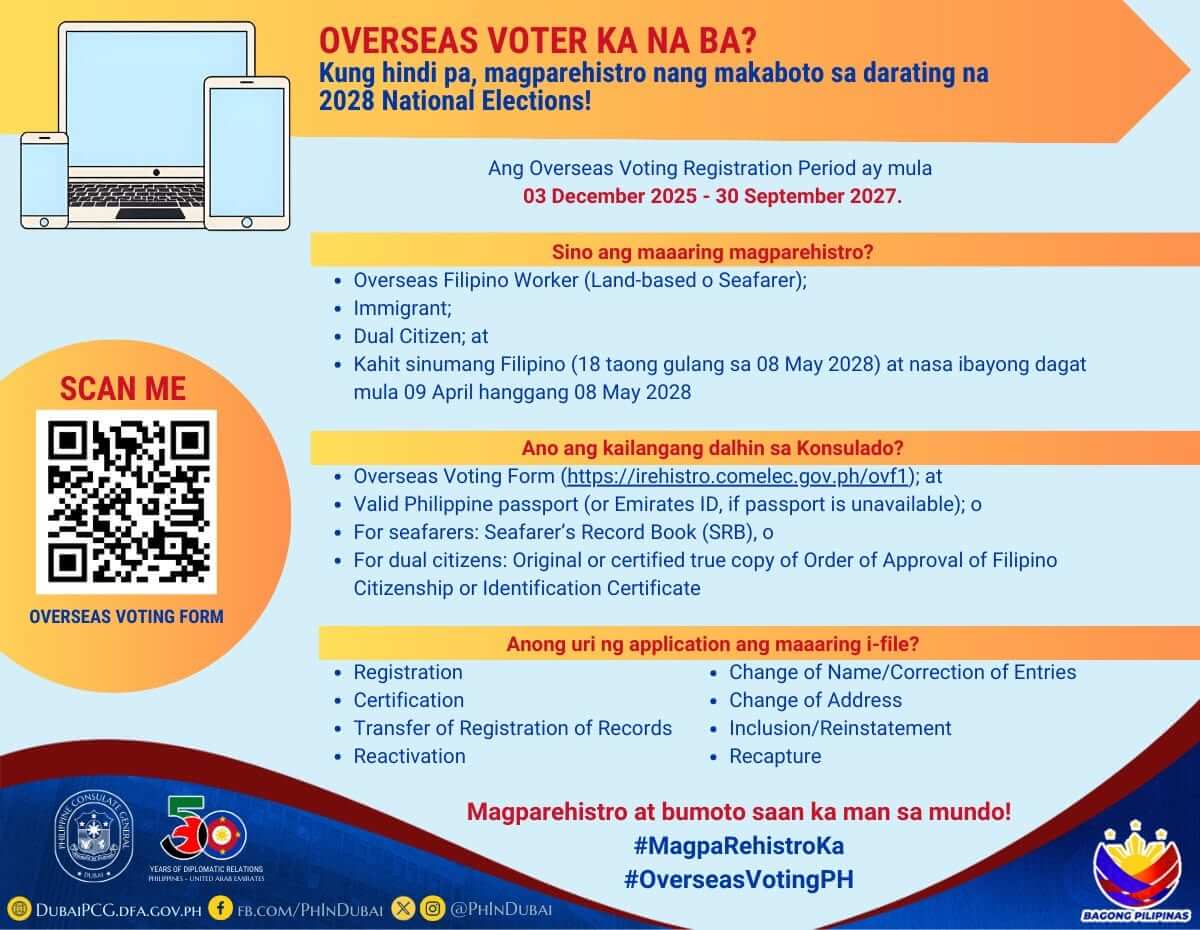
Registration Period: December 3, 2025 to September 27, 2027

The continuing registration cycle for overseas voting resumed on December 3, 2025. Qualified Filipinos in the UAE can register anytime from December 3, 2025 until September 27, 2027.

You can register online first, then appear in person at the Philippine Consulate General in Dubai (for those based in Dubai and the Northern Emirates) or at the Philippine Embassy in Abu Dhabi. The Resident Election Registration Board (RERB) reviews applications on a quarterly basis to keep the process transparent and accurate.

Bottom line: Complete both the online form and your in-person appearance within the registration window to secure your voter status.

overseas voting ph dubai registration
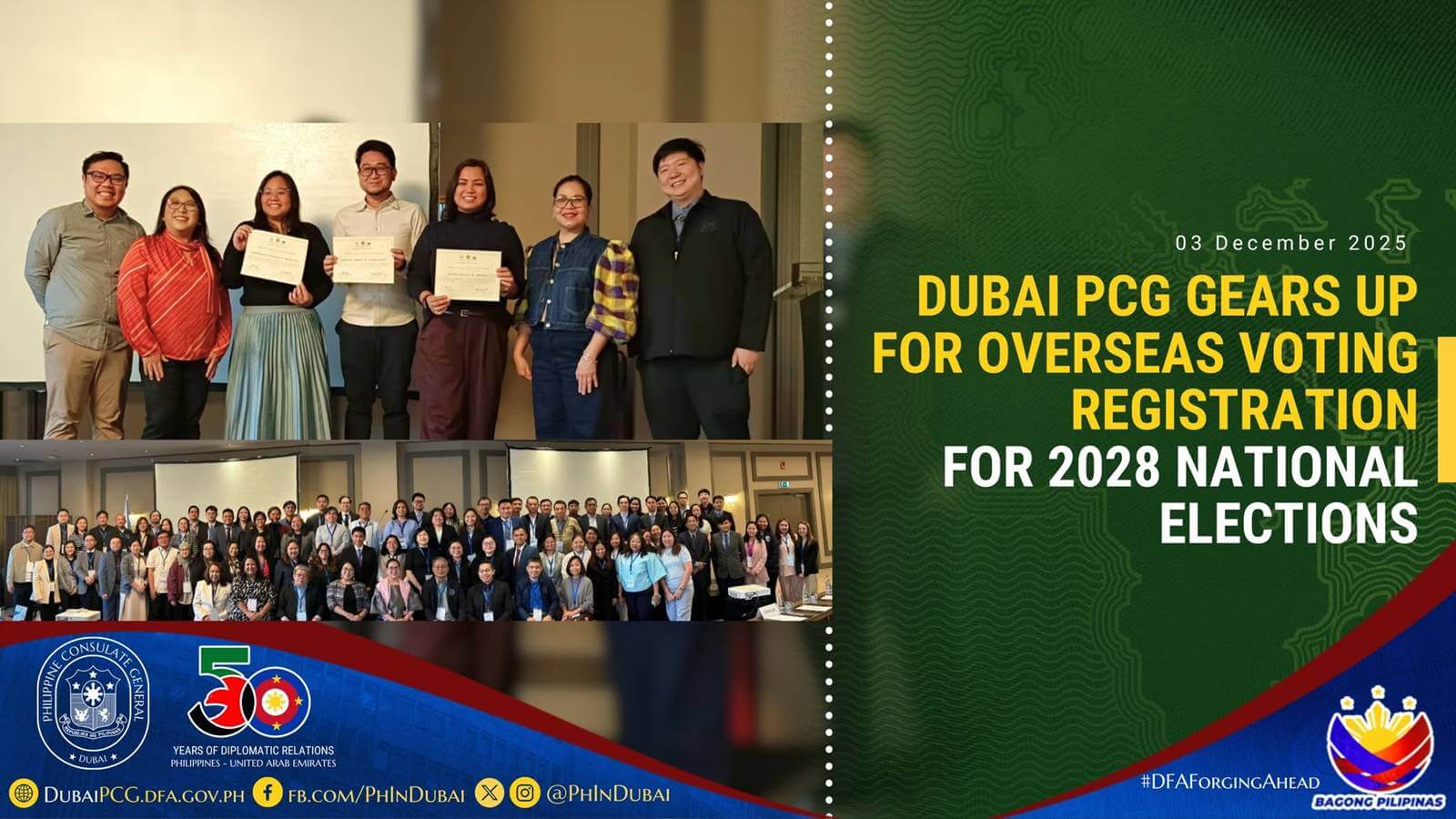
PCG Dubai gears up for overseas voting registration for the 2028 National Elections

Philippine National Election – May 8, 2028

The 2028 Philippine National Elections cover key positions, including the President, Vice President, Senators, and local officials. Both local and overseas Filipino voters will help choose leaders who will serve for the next six years.

Election day is scheduled for May 8, 2028, with overseas voting running from April 9 to May 8, 2028. The Commission on Elections (COMELEC) oversees the process, and automated voting machines will again be used for efficiency and accuracy.

Qualifications / Eligibility

To register as an overseas voter, you must:

  • Be a Filipino citizen, either by birth or naturalization
  • Be abroad, or plan to be abroad, during the voting period
  • Be at least 18 years old on May 8, 2028
  • Have no disqualifications under Philippine law

Who Are Disqualified?

You may be disqualified from voting if you have:

  • Lost your Filipino citizenship under Philippine law
  • Renounced your Philippine citizenship or pledged allegiance to a foreign country (except dual citizens under Republic Act 9225)
  • Been convicted of an offense punishable by at least one year of imprisonment (voting rights can be restored five years after completing your sentence, or through plenary pardon or amnesty)
  • Been declared insane or incompetent by a competent authority (this can be lifted with certification that you are no longer insane or incompetent)

Requirements

Gather the following before you register:

  1. Valid Philippine Passport – Bring the original and a photocopy of the relevant pages.
  2. No Valid Passport? – Obtain a certification from your foreign service post confirming your documents are sufficient for passport issuance, or that you are a valid passport holder who cannot present it for a valid reason.
  3. Seafarers – Include a photocopy of your Seaman’s Book or another document proving your seafaring status, in addition to the passport or certification above.
  4. Dual Citizens – Submit your Dual Citizenship certificate or Order of Approval (original and photocopy) with the documents above.
  5. Personal Appearance – Required in most cases to capture your biometrics.
  6. OVF 1 Form – Complete the Overseas Voting Form 1, available on the COMELEC website.

Note: Registered overseas voters with complete biometric data may use the Office for Overseas Voting’s (OFOV) Virtual Frontline Services (VFS) for certain applications. To transfer your registration to a Philippine municipality, city, or district, file your application at the local Office of the Election Officer where you intend to vote.

overseas voter registration procedure for filipinos in dubai philippine elections 2028

How to Register Online for Overseas Voting

Step 1: Gather the Necessary Documents

Prepare your valid Philippine passport. Dual citizens may use Dual Citizenship documents, and seafarers should have their Seaman’s Book ready.

Step 2: Fill Out the Application Form

Visit the COMELEC website and complete the iRehistro online form. This generates your OVF1 form with a QR code for verification.

Step 3: Submit the Application Form

Save the completed OVF1 form as a PDF, then print it on A4-sized paper. Personally submit the printed form at the nearest Overseas Voting (OV) registration site.

This process is governed by the Philippine Overseas Voting Act (R.A. 9189, amended by R.A. 10590) and overseen by the Office for Overseas Voting (OFOV).

How to Register OFW Voting at the Philippine Consulate General in Dubai

If you are based in Dubai or the Northern Emirates, follow these steps:

Step 1: Set an Appointment

Book an appointment through the Philippine Consulate General in Dubai’s official scheduling link – https://dubaipcg.dfa.gov.ph/overseas-voting-registration-appointment-portal

Step 2: Prepare Your Documents

On the day of your appointment, bring a copy of your passport and your completed OV registration form.

Step 3: Complete Your Registration

Proceed to the voter registration counter, where Consulate staff will assist you. Provide your personal details, verify that all information is accurate, and keep any confirmation or receipt as proof of your registration.

How to Vote as an OFW in Dubai – 3 Ways

Voting in Person using a Vote Count Machine (VCM)

Step 1: Confirm Your Registration

  • Ensure your name is registered on the Certified List of Overseas Voters (CLOV), which will be posted by the Philippine mission in Dubai at least 120 days before the election period. Once your registration is confirmed, prepare your documents for the election.

Step 2: Schedule Your Vote

  • Schedule a day to vote at the Philippine foreign post (embassy or consulate) in Dubai. Be aware of the specified time frame for overseas voters’ accommodation.

Important: Check the website or social media pages of the Philippine foreign post for health and safety protocols and follow them during the election period.

Step 3: Cast Your Vote

  • Upon arrival at the polling site, you will receive a ballot, a secrecy folder, and a pen.
  • Proceed to a voting booth and shade the ovals corresponding to your chosen candidates and party-list.
  • Hand your completed ballot to the Special Board of Elections Inspectors (SBIEs) for processing.
  • The machine will produce a receipt, which you should place in a designated box.

Voting in Person – Manual

Step 1: Verify Your Registration

  • Check the Certified List of Overseas Voters (CLOV) posted by the Philippine mission in Dubai at least 120 days before the election period. Once verified, prepare your documentary requirements for voting.

Step 2: Go to the Voting Location

  • Visit the designated Post Office or other approved voting locations in Dubai.
  • Present your valid passport or ID to the Electoral Board.
  • Provide your name and address for verification.

Step 3: Cast Your Vote

  • After verification, sign and affix your thumbmark to the List of Abroad Voters with Voting Records (OVF No. 2-A).
  • Receive a ballot and use a ballot secrecy folder to fill it out.
  • Fold the ballot as received and return it to the Poll Clerk, who will deposit it in the ballot box.
  • Supervision of the voting and vote counting is overseen by SBIEs.

Voting by Post Mail

Step 1: Receive Your Ballot

  • If you choose to vote by mail, expect to receive an envelope containing the Official Ballot, Certified List of Candidates, Instructions to Voters, Official Ballot envelope, and Paper Seals. You will need to complete this process independently.

Step 2: Complete and Seal the Ballot

  • Fill out the Official Ballot and place it in the “Ballot Envelope,” ensuring it remains undamaged.
  • In the designated section of the “Ballot Envelope,” write your full name and sign it, then seal it with a paper seal.

Step 3: Submit Your Ballot

  • You have the option to mail or physically deliver your sealed ballot to the Post Office.
  • Mail your ballot as early as possible to ensure it arrives at the Post Office on or before the specified deadline.

Note: Field voting centers or mobile voting centers may be available for a limited number of days.

Voting for Seafarers

Seafarers can vote at any Post that uses personal voting or, in the case of postal voting, at any Post with international seaports recognized and endorsed by the Department of Foreign Affairs-Overseas Voting Secretariat (DFA-OVS). Ensure you follow the respective procedures for your chosen voting method.

Contact Information

Philippine Consulate General in Dubai (PCG-Dubai)
Address: 851 Beirut St, Al Qusais 3, Dubai, United Arab Emirates
Contact number: +971 4 220 7100
Website: https://dubaipcg.dfa.gov.ph/
Facebook Page: https://www.facebook.com/PHinDubai
Office hours:
Monday to Thursday: 7:30 am to 3:30 pm
Friday: 7:30 am to 12:00 noon

Google Map Location

Map guide to the PCG Dubai office in Al Qusais, Dubai, UAE:

What is Overseas Voting?

Overseas voting refers to a voting system that allows citizens of a country who live abroad to participate in their home country’s elections. This is an important aspect of maintaining democratic principles as it ensures that every citizen, regardless of where they are located, has a say in their nation’s governance. The concept of overseas voting acknowledges the global nature of today’s world, where people move across borders for various reasons including work, education, or seeking better opportunities.

The importance of overseas voters cannot be overstated. They contribute significantly to the election outcomes in their home countries. Their votes can sway the results in closely contested elections, thereby playing a crucial role in deciding the future leadership and policies of their home countries. Ensuring that these voters have the means and the right to vote is therefore not just a matter of democratic principle, but can also have real, tangible effects on a country’s political landscape.

What is Absentee Voting?

DAbsentee voting is the same as overseas voting. This is another name for it but the context is the same.

It is a system that allows citizens who cannot physically be present in their home country (hence, they are ‘absent’ in their home country) on election day to still exercise their right to vote. Through absentee voting, they can cast their votes remotely and have them counted as part of the official results.

Absentee voting requires certain systems to be put in place so that overseas voters can easily access the relevant information and cast their votes. These systems need to be designed in a way that is secure, convenient and accessible for all overseas voters regardless of their location or other circumstances.

In some countries, absentee voting has been made easier by introducing online voting systems. This eliminates the need to fill out physical ballots – which can be tedious and time-consuming – allowing overseas voters to quickly and conveniently cast their votes.

The Role of Overseas Voters in Democracy

Overseas voters play a crucial role in upholding democracy by allowing citizens who live outside of their home countries, for whatever reason, to still have a say in the political decisions that affect them. By granting these citizens with the right to vote, it ensures that their voices are heard and their opinions are considered in the decision-making process.

In addition, overseas voting can help to ensure that a country’s elections are fair and transparent – as accusations of fraud or mishandling of votes can be reduced when citizens living abroad have the opportunity to cast their ballots without interference. This ensures that all eligible voters get an equal chance to express

Absentee voting is a form of overseas voting, where citizens who are currently abroad can submit their ballots for the elections in their home country. Absentee voting is beneficial to those who cannot physically be present to vote in their home country, either due to work commitments or other personal issues. It enables them to still have an active voice in their country’s governance by allowing them to cast their vote remotely.

Overseas voting is an important aspect of maintaining democratic principles and ensuring that all citizens have a say in their nation’s political future. By introducing secure, accessible systems for overseas voting, countries can guarantee that the voices of all citizens are heard, no matter where they live.

Who are Overseas Voters?

Overseas voters are defined as citizens of a country who are eligible to vote but reside in a different country at the time of an election. They may be abroad for various reasons such as employment, education, or due to marriage or other family circumstances. The specific criteria for who qualifies as an overseas voter can vary from one country to another, depending on the respective national laws.

According to the International Institute for Democracy and Electoral Assistance, there were approximately 115 million people living outside their home country who were eligible to vote in their home country’s elections as of 2017. This number is likely to have increased in recent years due to globalization and increased mobility. These voters represent a significant demographic that can influence election outcomes in their home countries.

The Legal Framework for Overseas Voting

International laws and treaties often support the right of citizens to participate in their home country’s elections, regardless of where they live. This is based on the principle that citizenship, rather than residence, should determine a person’s political rights. The Universal Declaration of Human Rights, for instance, states that everyone has the right to take part in the government of their country, directly or through freely chosen representatives.

On a national level, the legal provisions for overseas voting vary widely. Some countries, like France and Italy, even reserve seats in their parliaments for representatives of their citizens living abroad. Other countries, like Ireland, do not allow their citizens abroad to vote in national elections at all. Many countries fall somewhere in between, allowing overseas voting under certain conditions or for certain types of elections.

Challenges Faced by Overseas Voters

Overseas voters face a unique set of challenges that can make it difficult for them to exercise their voting rights. Logistical issues, such as the need to register for an absentee ballot and ensuring that the ballot is returned in time to be counted, can pose significant hurdles. Some voters may also find it challenging to stay informed about the candidates and issues in their home country’s elections due to language barriers or limited access to relevant news and information.

Legal complexities can also create obstacles for overseas voters. The laws governing overseas voting vary widely from one country to another, and it can be challenging for voters to understand and comply with these rules. Additionally, some countries require voters to maintain a certain level of ties to their home country in order to be eligible to vote, which can be difficult for those who have been living abroad for an extended period.

Solutions and Innovations in Overseas Voting

Technological advancements have the potential to greatly simplify the process of overseas voting. Online voting, for example, could eliminate many of the logistical challenges associated with voting from abroad. However, this approach also raises concerns about security and the potential for fraud or interference.

Policy changes can also make a big difference. Simplifying the registration process, extending deadlines, and providing clear and accessible information about how to vote from abroad can all help to make overseas voting more accessible. Advocacy groups also play a key role in pushing for these changes and supporting overseas voters.

Case Studies: Overseas Voting in Different Countries

Different countries have different approaches to overseas voting. In the United States, for instance, the Uniformed and Overseas Citizens Absentee Voting Act (UOCAVA) allows U.S. citizens living abroad to vote in federal elections. The process involves applying for an absentee ballot, which can be sent via mail, fax, or email.

In the United Kingdom, British citizens living abroad can register as an overseas voter and vote in general elections and referendums. They can vote either by post, by proxy (appointing someone else in the UK to vote on their behalf), or in person if they will be in the UK on election day.

Australia allows its citizens living abroad to vote in federal elections if they left Australia within the last six years and intend to return. India allows its citizens living abroad (known as Non-Resident Indians) to vote in person at their local embassy or consulate, but does not currently allow postal or online voting.

In contrast, Canada had a law until recently that barred Canadian citizens who had lived abroad for more than five years from voting in federal elections. This law was challenged in court and ultimately struck down, restoring voting rights to more than one million Canadians living abroad.

The Impact of Overseas Voters on Election Outcomes

The influence of overseas voters on election outcomes can be significant, especially in closely contested races. For example, in the 2000 U.S. presidential election, the overseas ballots played a decisive role in the Florida vote count, which ultimately determined the outcome of the entire election.

Despite their potential impact, the voting rate among overseas citizens is generally much lower than among those living in their home country. This is due to a variety of factors, including the challenges mentioned above and a sense of disconnection or lack of engagement with the politics of their home country.

Summary

Overseas voters represent a significant and growing demographic that has the potential to influence election outcomes in their home countries. Despite the challenges they face, there are many solutions and innovations, particularly technological ones, that can make overseas voting easier and more accessible.

As the world becomes more interconnected, the importance of overseas voters is likely to increase. Ensuring that these voters can exercise their voting rights is not only a matter of maintaining democratic principles, but could also have real, tangible effects on the political landscape of countries around the world.

iRehistro: How Filipino Voters Can Register Online

Did you know that on May 15, 2015, the Commission on Elections (COMELEC) launched a groundbreaking initiative known as iREHISTRO? This online application form accomplishment and submission system marked a significant leap forward in voter registration for Filipino citizens. If you’re a Filipino citizen, at least 18 years old by May 9, 2016, and not disqualified by law, this system provided an accessible way to prepare for the 2016 Presidential Elections.

The iREHISTRO system was designed to simplify the voter registration process for overseas voters. Instead of spending longer periods at the Embassy or Consulate in person or a registration venue, Filipino registrants could now use this innovative online system. Its primary goal was to reduce the time and effort required for registrants to complete their voter registration applications. If it’s your first time to vote or have only learned about this platform just now, keep on reading.

How to Start Your Voter Registration Online with iRehistro
Credits: COMELEC

What is iREHISTRO?

iREHISTRO provides a streamlined solution for Filipino citizens seeking to participate in the voter registration process.

Unlike a full online registration system, its primary purpose is to facilitate the completion of the OVF1 form with a QR code.

This innovative approach simplifies the initial steps of voter registration by allowing users to input their necessary information electronically.

After this, users are prompted to save a PDF copy of the accomplished OVF1 form on their device and subsequently print it on A4-sized paper.

This printed document, bearing the QR code, serves as their OVF1 form, which must be submitted in person at the nearest OV registration site for further processing, adhering to the provisions of Sec. 6 of Republic Act No. 10590.

It’s important to note that iREHISTRO prioritizes user privacy, as no personal data is stored or retained on any server after the form generation process.

However, if the system-generated PDF file is lost or deleted, users will need to repeat the process to generate another OVF1 form.

Advantages of Using iREHISTRO

Aside from convenience, there are several notable advantages to using iREHISTRO in the context of voter registration for Filipino citizens, both locally and abroad:

Efficient Time Management

  • iREHISTRO significantly reduces the time required for voter registration.
  • By allowing users to input their information electronically, it eliminates the need for time-consuming visits to registration venues.
  • This efficiency is especially beneficial for busy individuals or those residing far from registration sites.

Accessibility for Overseas Voters

  • iREHISTRO is particularly valuable for overseas Filipino voters.
  • It enables them to engage in the registration process without the need to physically visit an embassy or consulate, making it more accessible for Filipinos living abroad who wish to exercise their voting rights.

Reduced Bureaucratic Hurdles

  • Traditional voter registration processes can sometimes involve complex paperwork and bureaucratic procedures.
  • iREHISTRO simplifies this by providing a user-friendly digital interface, reducing the likelihood of errors and making the registration process smoother.

Data Privacy Assurance

  • iREHISTRO places a strong emphasis on data privacy.
  • The system does not save or retain any personal data on servers after the form generation process.
  • This commitment to data security ensures that users’ information remains confidential and protected.

Convenient Reprint Option

  • In the event that users lose or delete their system-generated PDF file, iREHISTRO offers the convenience of generating another OVF1 form.
  • This feature reduces the stress associated with the potential loss of crucial registration documents.

Qualifications:

  1. Filipino Citizenship: iREHISTRO is exclusively for Filipino citizens. To use this system, you must be a Filipino national.
  2. Age Requirement: You must be at least 18 years old by the date of the upcoming election. For example, if you plan to vote in the 2022 election, you should be at least 18 years old by the election date.
  3. Not Disqualified by Law: Individuals who are disqualified from voting under Philippine law are not eligible to use iREHISTRO. Disqualifications can include criminal convictions, certain legal judgments, and other legal restrictions. Ensure that you meet the legal requirements to vote.

Requirements:

  1. Access to a Device: To use iREHISTRO, you need access to a computer, smartphone, or tablet with an internet connection. This will enable you to access the online system and complete the necessary forms.
  2. Personal Information: Prepare all the required personal information and documents, including your full name, date of birth, address, and relevant identification documents (e.g., passport, government-issued ID, or birth certificate). You’ll need these details to complete the voter registration application.
  3. A4-Sized Paper and Printer: After completing the online registration process, you must print the system-generated PDF file, which contains the accomplished OVF1 form with a QR code. Make sure you have access to an A4-sized paper and a working printer.
  4. OV Registration Site Information: You’ll need to know the location of the nearest Overseas Voting (OV) registration site where you plan to submit your printed OVF1 form. This information is crucial for the final step of the registration process.

It’s essential to meet the qualifications and have all the necessary requirements in place before using iREHISTRO. By doing so, you can ensure a hassle-free and successful voter registration process, whether you’re an overseas voter or a resident of the Philippines, and make your voice heard in the democratic process.

iREHISTRO Process Overview

The process involves filling out the Voters Registration Application Form online, and once completed, the applicant simply needs to present the printed form to the OV Operator.

The final step includes having their biometrics taken and completing the registration process efficiently and conveniently.

Step-by-Step Guide to Using iREHISTRO

Step 1: Accomplish a Voter Registration Form

New registrations and reactivation of registrations, both local and Overseas Filipino Workers (OFWs), must first complete the Voter Registration form before proceeding to your local COMELEC office or Philippine Embassy.

  1. Online Application or Registration on iRehistro:
  2. Open any web browser and go to this link: iREHISTRO
  3. You will be redirected to COMELEC’s official website. Carefully select whether you are a local or overseas applicant.
  4. A disclaimer notice will appear; read it carefully and click “continue” once done.
  5. You will be asked to specify the type of application you are registering for (new registration, reactivation, change or updating details, or transfer of record). Click “Registration” if you are a new registrant.
  6. You will be directed to the Voter Registration Forms. Input your personal details, ensuring that all information is filled out accurately. Double-check all details before proceeding.
  7. Once all forms are completed, set an appointment for biometrics and the submission of forms to your local COMELEC office.
  8. A PDF file will be generated; save it to your computer and print three (3) copies.
  9. Printed Copies: If you are unable to complete the online registration, you have the option to print out the forms and manually fill them. Print three (3) copies of the Voter Registration Form on legal-sized bond paper and accurately fill out all your personal details. You can obtain a copy of this form on irehistro.comelec.gov.ph or at your nearest Embassy or Consulate.

Step 2: Prepare All the Requirements

Before going to your local COMELEC office, ensure that you have prepared all the necessary requirements for a smooth registration process.

1. Three (3) copies of the filled-out Voter Registration Form.

2. One (1) valid ID and provide a photocopy of the ID you will present. The ID must indicate your current address. Valid government IDs include:

– SSS/GSIS/UMID,

– PRC ID,

– Driver’s License,

– Senior Citizen ID,

– Postal ID,

– IBP ID,

– Passport,

– NBI Clearance,

– Certificate of Confirmation from the NCIP, and

– School ID.

3. Bring your own ballpoint pen and wear a facemask and face shield. Follow the health protocols and maintain social distancing within the COMELEC premises.

Step 3: Visit Your Local COMELEC Office for the Submission of Requirements and Biometrics

COMELEC offices are typically open from Monday to Thursday, 8 a.m. to 5 p.m. The acceptance of appointments may vary by location—some accept online appointments, while others accept walk-in applicants. Coordinate with your nearest Embassy or Consulate for announcements and notices.

Upon arrival, register and receive a number or proceed to the waiting line. Complete the Health Declaration Form provided upon entering the premises, as needed.

Video: Comelec holds online voting demo for overseas voters | New Day

In this video, we dive into a significant development in the Philippines’ electoral process.

The Commission on Elections (COMELEC) has given the green light to internet voting for registered overseas voters in the upcoming 2025 national and local elections.

Comelec Chairman George Garcia emphasizes the aim of increasing voter turnout, as the previous election recorded a modest 39 percent participation rate among overseas voters.

With a budget of P411 million invested, this move seeks to explore a more accessible and efficient way for overseas Filipinos to cast their votes, moving away from traditional methods like voting in person or via mail.

Learn more about this innovation’s implications and the roadmap for the exciting venture into electronic voting for overseas Filipinos by watching the entire clip.

Why Participate in the Philippine Elections 2028 as an Overseas Voter

Voting in the Philippine elections as an overseas voter is one of the most important things you can do. It’s your constitutional right — and your chance to have a say in who leads the country, no matter where you are in the world.

The officials we elect make key decisions about how the country is run, where resources go, and how our needs are represented on the national stage. So every vote counts, including yours!

reasons to vote overseas
Credits: PNA


Philippine elections hold politicians accountable and push them to act on what matters to the public. Overseas Absentee Voting (OAV) recognizes that Filipinos abroad have the same rights as those back home — and that their voices matter just as much in shaping the country’s future.

For overseas Filipinos, participating in the electoral process instills a sense of identity and belonging, affirming their concern for the country’s development and future.

Philippine Elections 2028: Key Dates for OFWs

Mark your calendars! The Philippine Elections 2028 is coming up, and here’s what overseas voters need to know:

  • Voter Registration Period: December 3, 2025 – September 30, 2027
  • OFW Voting Period: April 9 – May 8, 2028 (1 month before the elections day)
  • Philippine National Elections Day – May 8, 2028

If you haven’t registered yet, now is the time to start. Don’t miss your chance to vote in the 2028 elections!

Why Participate in Overseas Absentee Voting

OAV isn’t just a process — it’s your way of showing up for the Philippines, even from abroad. Here’s why your vote matters:

  • Civic Duty: Voting is your responsibility as a Filipino citizen and the most direct way to shape the country’s future.
  • Impact on Policies: Your vote influences key government decisions on healthcare, education, the economy, and foreign relations.
  • Safeguard Interests: Support candidates and policies that reflect your values and the needs of fellow Filipinos.
  • Representation: Active overseas voters push elected officials to pay attention to OFW concerns.
  • Strengthen Democracy: Your participation helps keep the democratic system strong and healthy.
  • Cultural Identity: Voting keeps you connected to your roots, no matter where you live.
  • Back Good Governance: Your ballot can put transparent and accountable leaders into office.
  • Global Impact: Your vote can shape how the Philippines engages with the world.
  • Catalyst for Change: Every vote can push the country in a better direction.
  • Lead by Example: When you vote, you inspire other OFWs in your community to do the same.
  • Preserve Democracy: Voting today helps ensure the next generation inherits a just and democratic society.

Overseas Absentee Voting (2022): By the Numbers

In 2022, nearly 1.7 million Filipinos abroad took part in the Overseas Absentee Voting (OAV) process, which started a month before the local voting period, according to the Commission on Elections (COMELEC).

Here’s a quick breakdown:

  • Total registered overseas voters: 1,697,215
  • Land-based voters: 1,677,631
  • Sea-based voters: 19,584

By region:

  • Middle East and Africa: 786,997
  • Asia Pacific: 450,282
  • North and Latin America: 306,445
  • Europe: 153,491

By gender:

  • Female voters: 1,072,159
  • Male voters: 625,056

These numbers show just how big a role overseas Filipinos play in national elections — and why every registration and every vote matters.

Frequently Asked Questions about

1. What is Overseas Absentee Voting (OAV)?

OAV allows Filipino citizens living abroad to vote in Philippine elections. It’s your way of participating in the democratic process from wherever you are in the world.

2. Who is eligible for Overseas Absentee Voting?

Generally, Filipino citizens living or working abroad — whether temporarily or permanently — are eligible. Check with COMELEC or your nearest Philippine embassy for specific requirements.

3. How do I register for Overseas Absentee Voting?

You can register at your nearest Philippine embassy or consulate. You’ll typically need to show proof of citizenship and your current status abroad. For the 2028 elections, registration runs from December 3, 2025 to September 30, 2027.

4. What elections can I participate in through OAV?

Overseas voters can participate in national elections, including presidential and senatorial races.

5. How can I receive my ballot as an overseas voter?

This depends on your location. Ballots may be mailed to your registered address or made available at your embassy or consulate. Check with COMELEC for details specific to your country.

6. How do I return my completed ballot?

You can typically mail your ballot back or drop it off at designated locations in your embassy or consulate. Follow the instructions from COMELEC carefully.

7. Can I vote in person as an overseas voter?

Some countries have designated polling stations for overseas voters. However, most OAV is done through postal or embassy-based methods. Check with your local Philippine embassy for options.

8. How can I verify that my vote was counted?

Many countries offer online tracking systems or allow you to follow up directly with election authorities. It’s a good idea to check that your vote was received and counted.

Video: Amid OAV delays and irregularities, US-based Filipinos take matters into their own hands

This video looks at some of the challenges overseas Filipinos faced during the 2022 OAV, particularly in the US. It’s a reminder that the OAV experience can vary greatly depending on location — and that there’s still room for improvement in terms of logistics and security.

But what stands out most is the resilience of Filipino communities abroad. Despite the hurdles, they found ways to make their voices heard. Watch the full video to learn more.

Summary

Voting as an overseas Filipino isn’t just a civic duty — it’s a powerful way to stay connected to your homeland and help shape its future.

The officials you elect will make decisions that affect millions of Filipinos, including you and your family back home. Your vote gives you a say in who those leaders are and what they stand for.

With the Philippine Elections 2028 on the horizon, now is the time to act. If you’re not yet registered, the registration period runs from December 3, 2025 to September 30, 2027. The OFW voting period will be from April 9 to May 8, 2028.

Don’t let distance stop you from making a difference. Register, vote, and show that no matter where you are, you’re still proudly Filipino.

error: Content is protected !!