How to Register as an Absentee Voter in the Hong Kong Elections

As a Hong Kong citizen living abroad, you may be wondering how you can participate in the upcoming Hong Kong elections. The good news is that you can register as an overseas voter and have your say in the democratic process.

In this guide, we’ll be sharing with you the steps you need to take to register as an overseas voter and cast your vote in the Hong Kong elections. Let’s get started!

Eligibility Criteria

Basic Requirements

To be eligible to vote in the Hong Kong elections, you must meet the following basic requirements:

  • You must be a Hong Kong citizen
  • You must be at least 18 years old on or before the election day
  • You must not have been convicted of any corrupt or illegal conduct related to an election

Special Requirements for Overseas Residents

If you are an overseas Hong Kong resident, you must meet the following additional eligibility criteria:

  • You must have been a registered voter in Hong Kong before leaving the city
  • You must have lived in Hong Kong for at least seven years before leaving the city, or you must have been born in Hong Kong and have a parent who meets this requirement
  • You must not have acquired any right of abode or right to land in any foreign country
  • You must not have registered as an overseas voter in any other country or territory

If you meet these requirements, you are eligible to register as an overseas voter and participate in the Hong Kong elections.

The Application Process

Sure, here’s the section you requested:

Necessary Documents

To register as an overseas voter in the Hong Kong elections, you will need to provide the following documents:

  • A valid Hong Kong permanent identity card or a valid Hong Kong SAR passport
  • Proof of overseas residence, such as a utility bill or a bank statement

Make sure that these documents are up-to-date and valid before submitting your application.

Application Form

You can find the application form for overseas voter registration on the website of the Registration and Electoral Office (REO) of Hong Kong. The form is available in both English and Chinese, so make sure to choose the language that you are most comfortable with.

When filling out the application form, be sure to provide accurate and complete information. Any errors or omissions may delay the processing of your application.

Submission

Once you have completed the application form and gathered the necessary documents, you can submit your application to the REO by mail or in person. If you choose to submit your application by mail, make sure to send it to the correct address and allow enough time for delivery.

If you prefer to submit your application in person, you can do so at the Hong Kong Economic and Trade Office (HKETO) nearest to your place of residence. The HKETO will forward your application to the REO for processing.

Confirmation and Follow-up

After submitting your application, you will receive a confirmation notice from the REO within 21 days. This notice will confirm that your application has been received and is being processed.

If your application is approved, you will receive a notification from the REO with instructions on how to cast your vote in the Hong Kong elections. If your application is not approved, you will receive a notice explaining the reason for the rejection.

If you have any questions or concerns about your application, you can contact the REO for assistance.

Deadlines

Application Deadline

If you’re planning to register as an overseas voter for the upcoming Hong Kong elections, it’s important to note the application deadline. Eligible residents and registered electors can submit their “Application for New Registration / Report on Change of Particulars by an Elector in a Geographical Constituency” (REO-GC) at any time of the year. However, if you want your registration processed or your particulars updated in the register of electors to be published in the same cycle, you must submit your application forms to the relevant office on or before the statutory deadlines. For new voter registration and reports on change of particulars by an elector, the deadline is June 2nd.

Other Important Dates

Apart from the application deadline, there are other crucial dates to keep in mind. The electoral roll is finalized on July 2nd, which means that any changes made to your registration after this date will not be reflected in the electoral roll for the upcoming elections. Additionally, ballots are typically sent out to overseas voters around two weeks before the election day. It’s important to keep these dates in mind to ensure that you’re able to participate in the Hong Kong elections as an overseas voter.

Another important date to keep in mind is when ballots are sent out. For overseas voters, ballots are typically sent out around two weeks before the election date. It’s important to make sure that you have provided the correct mailing address when registering as an overseas voter to ensure that you receive your ballot in a timely manner.

Voting Methods

Postal Voting

One of the most common ways for overseas voters to cast their vote in the Hong Kong elections is through postal voting. To do this, you will need to apply for a postal vote by filling out the relevant form and submitting it to the Electoral Affairs Commission (EAC) before the deadline. Once your application is approved, you will receive a ballot paper in the mail, which you can fill out and return to the EAC by post.

It’s important to note that postal voting can take longer than other methods, so it’s recommended that you apply for a postal vote as early as possible to ensure that your vote is counted.

Proxy Voting

If you are unable to vote in person or by post, you can also assign a proxy to vote on your behalf in Hong Kong. To do this, you will need to fill out a proxy form and submit it to the EAC before the deadline. Your proxy will then be able to cast your vote at a polling station in Hong Kong on election day.

It’s important to choose a trustworthy proxy who will vote according to your wishes and to ensure that they are able to attend a polling station in Hong Kong on election day.

Voting in Person

If you happen to be in Hong Kong on election day, you may be able to vote in person at a polling station. However, it’s important to note that you will need to be registered as an overseas voter and have applied for a Certificate of Absentee Registration before the deadline in order to do so.

If you are eligible to vote in person, you will need to bring your Certificate of Absentee Registration and a valid form of identification to the polling station on election day. You will then be able to cast your vote in the same way as any other registered voter in Hong Kong.

Frequently Asked Questions

1. Who is eligible to register as an overseas voter in the Hong Kong elections?

Hong Kong permanent residents who are living abroad and have not given up their right of abode in Hong Kong are eligible to register as overseas voters.

2. How can I register as an overseas voter?

You can register as an overseas voter by filling out the relevant form and submitting it to the Electoral Affairs Commission (EAC) before the deadline.

3. What is the deadline for registering as an overseas voter?

The deadline for registering as an overseas voter varies depending on the election. You should check the EAC website for the latest information.

4. Can I register as an overseas voter if I am already registered to vote in Hong Kong?

No, you cannot register as an overseas voter if you are already registered to vote in Hong Kong.

5. Can I vote in both the geographical and functional constituencies as an overseas voter?

Yes, you can vote in both the geographical and functional constituencies as an overseas voter.

6. How can I cast my vote as an overseas voter?

You can cast your vote as an overseas voter through postal voting, proxy voting, or in person if you are in Hong Kong on election day.

7. What is a Certificate of Absentee Registration?

A Certificate of Absentee Registration is a document that confirms your registration as an overseas voter and allows you to vote in person at a polling station in Hong Kong on election day.

8. Can I change my voting method after I have registered as an overseas voter?

Yes, you can change your voting method by submitting a new application to the EAC before the deadline. However, you should note that changing your voting method may affect the deadline for submitting your vote.

Summary

In conclusion, as a Hong Kong citizen living abroad, you have the right to participate in the democratic process by registering as an overseas voter and casting your vote in the Hong Kong elections. Whether you choose to vote by postal voting, proxy voting, or in person, it’s important to follow the steps outlined in this guide and ensure that you meet the eligibility criteria and deadlines. By taking part in the elections, you can have a say in the future of Hong Kong and make your voice heard. So don’t hesitate to register as an overseas voter and exercise your right to vote!

Hong Kong Elections: What You Need to Know

Elections are a cornerstone of democracy, allowing citizens to have a say in the decision-making process and shape the future of their country. Hong Kong, with its unique blend of British colonial past and current relationship with China, is no exception. However, navigating the Hong Kong elections can be challenging, especially for residents based abroad.

Learn more about the Hong Kong elections, including the voting process, key issues at stake, and the candidates running for office. By providing this information, we hope to empower Hong Kong citizens to participate in the democratic process and make their voices heard in Hong Kong.

Historical Background

Hong Kong has a unique political history and relationship with mainland China. After being a British colony for over 150 years, Hong Kong was returned to China in 1997 under the “One Country, Two Systems” policy. This policy allows Hong Kong to maintain a separate legal and economic system from mainland China, with a high degree of autonomy and freedom of speech and assembly.

However, in recent years, there has been growing concern over the erosion of Hong Kong’s autonomy and the increasing influence of mainland China on its political and social systems. This has led to widespread protests and calls for greater democracy and autonomy in Hong Kong.

The situation in Hong Kong has become a major international issue, with many countries expressing concern over the erosion of Hong Kong’s autonomy and the potential impact on global trade and security. The future of Hong Kong’s political system and relationship with mainland China remains uncertain, and it is likely to continue to be a topic of debate and discussion in the years to come.

Types of Elections in Hong Kong

The Legislative Council (LegCo) Elections, Chief Executive Elections, and District Council Elections are all important elections in Hong Kong. The LegCo is the legislative body of Hong Kong, responsible for enacting laws and overseeing the work of the government. The Chief Executive is the head of the Hong Kong government, responsible for implementing policies and managing the administration of the city. The District Councils are the local government bodies responsible for managing the affairs of the 18 districts of Hong Kong.

The LegCo Elections are held every four years and are contested by both directly elected and indirectly elected members. The Chief Executive Elections are held every five years and are contested by a small committee of 1,200 members, with the winner appointed by the central government in Beijing. The District Council Elections are held every four years and are contested by directly elected members.

In recent years, these elections have become increasingly contentious, with pro-democracy and pro-Beijing factions vying for control. The 2019 District Council Elections saw a record turnout and a landslide victory for pro-democracy candidates, which was seen as a rebuke to the pro-Beijing establishment.

The LegCo Elections and Chief Executive Elections are also closely watched by the international community, as they are seen as a barometer of Hong Kong’s autonomy and the state of its relationship with mainland China. The 2020 LegCo Elections were postponed due to the COVID-19 pandemic, and the future of the elections remains uncertain in the face of ongoing political tensions and protests in Hong Kong.

Legislative Council (LegCo) Elections

  • The Legislative Council (LegCo) is the unicameral legislature of Hong Kong, responsible for enacting laws, approving budgets, and monitoring the work of the government.
  • The LegCo is composed of 70 members, with 35 elected by geographical constituencies and 35 elected by functional constituencies.
    • The voting system used in the LegCo elections is Proportional Representation, which means that seats are allocated to parties based on the proportion of votes they receive.
  • The LegCo elections are important for the residents of Hong Kong because they provide an opportunity for them to have a say in the governance of their city and to hold their elected representatives accountable.
  • The LegCo has the power to initiate and amend legislation, approve government budgets, and investigate government policies and actions.
  • The LegCo also plays a crucial role in ensuring that the government is accountable to the people of Hong Kong and that their rights and freedoms are protected.
  • The LegCo elections are particularly important in the current political climate, as Hong Kong residents continue to demand greater autonomy and democracy in the face of increasing pressure from the Chinese government.
  • By participating in the LegCo elections, Hong Kong residents can make their voices heard and help shape the future of their city.

Chief Executive Elections

  • The Chief Executive is the highest-ranking official in Hong Kong and serves as the head of the government.
  • The Chief Executive is responsible for implementing policies and laws, as well as representing Hong Kong in international affairs.
  • The Election Committee is responsible for selecting the Chief Executive and is made up of 1,200 members from various sectors of society, including business, politics, and social organizations.
  • The Election Committee is designed to ensure that the Chief Executive is selected by a broad cross-section of society and is not influenced by any one group or interest.
  • Recent changes to the election process have sparked controversy and protests in Hong Kong. In 2019, the Hong Kong government proposed a bill that would allow extradition to mainland China, which many saw as a threat to Hong Kong’s autonomy and civil liberties.
    • The proposed bill sparked widespread protests and calls for greater democracy in Hong Kong, including demands for universal suffrage in the Chief Executive elections.
  • In response to the protests, the Hong Kong government suspended the bill and made some concessions, but the underlying issues of democracy and autonomy remain unresolved.
  • The Chief Executive elections continue to be a contentious issue in Hong Kong, with many calling for greater transparency and accountability in the election process.

District Council Elections

  • District Councils are local government bodies in the United States that are responsible for managing and providing services to specific geographic areas within a city or county.
  • The role of District Councils is to represent the interests of their constituents and to provide a forum for community engagement and decision-making.
    • District Councils are typically made up of elected officials who serve for a set term, usually two to four years.
    • To be eligible to vote in District Council elections, you must be a registered voter and reside within the boundaries of the district.
  • The specific eligibility requirements may vary by district, so it is important to check with your local election office to determine if you are eligible to vote.
  • District Council elections are held on a regular basis, typically every two to four years, depending on the district.
  • The election process may vary by district but typically involves a primary election to narrow down the field of candidates, followed by a general election to determine the winner.
  • District Council elections are an important opportunity for citizens to have a say in local government and to help shape the policies and decisions that affect their communities.
  • By staying informed about the candidates and issues, and by exercising your right to vote, you can help ensure that your voice is heard in the democratic process and that your community is represented in local government.

Current Landscape

Hong Kong’s political landscape has been dominated by pro-Beijing parties in recent years.

The most recent election in 2019 saw a historic victory for pro-democracy candidates, who won a majority of seats in the district council elections.

This was seen as a significant blow to the pro-Beijing establishment and a sign of growing support for democratic values in Hong Kong.

The election results were seen as a referendum on the ongoing protests in Hong Kong, which have been calling for greater autonomy and democratic reforms.

  • The pro-democracy candidates campaigned on a platform of greater accountability and transparency in government, as well as a commitment to protecting civil liberties and human rights.
  • The election results could have significant implications for future policies and governance in Hong Kong, as pro-democracy candidates now have a greater voice in local government.

However, it remains to be seen how much power they will actually have, as the district councils have limited authority, and the central government in Beijing still holds significant influence over Hong Kong’s political system.

The ongoing protests and political unrest in Hong Kong have highlighted the deep divisions within the city and the challenges of balancing the interests of different groups and stakeholders.

The future of Hong Kong’s political landscape remains uncertain, but the recent election results have shown that there is a growing demand for democratic reforms and greater autonomy in the city.

Summary

In conclusion, the Hong Kong elections are an important opportunity for citizens to have a say in the future of their city. Despite the challenges of navigating the political landscape, it is important for Hong Kong residents, including those based overseas, to participate in the democratic process and make their voices heard. By staying informed about the issues at stake and the candidates running for office, Hong Kong citizens can help shape the future of their city and ensure that their values and beliefs are represented in the decision-making process.

Certified List of OFW Voters (CLOV) 2028 in Hong Kong

Attention Filipinos in Hong Kong! If you have registered to vote in the 2028 elections, you can check your eligibility by finding your name on the certified list of overseas voters(CLOV) issued by the Philippine Consulate-General in Hong Kong.

Once available, PCG Hong Kong will issue a list of Filipino voters in this region, which can be accessed by visiting the Consulate-General website or checking the files listed below. Don’t miss your chance to exercise your right to vote and make your voice heard in the Philippine elections.

clov ofw filipino voters list in Hong Kong

Registration for OFW voters for 2028 PH elections in Hong Kong is available and you can update personal details on their voter record, check their registration status, or reactivate a deactivated voter record. All you need is a valid Philippine passport. Visit the Philippine Consulate-General in your area to get started.

With only 360 days left to register as an overseas voter, Filipinos in Hong Kong are encouraged to take advantage of these preparations and exercise their right to vote in the upcoming elections.

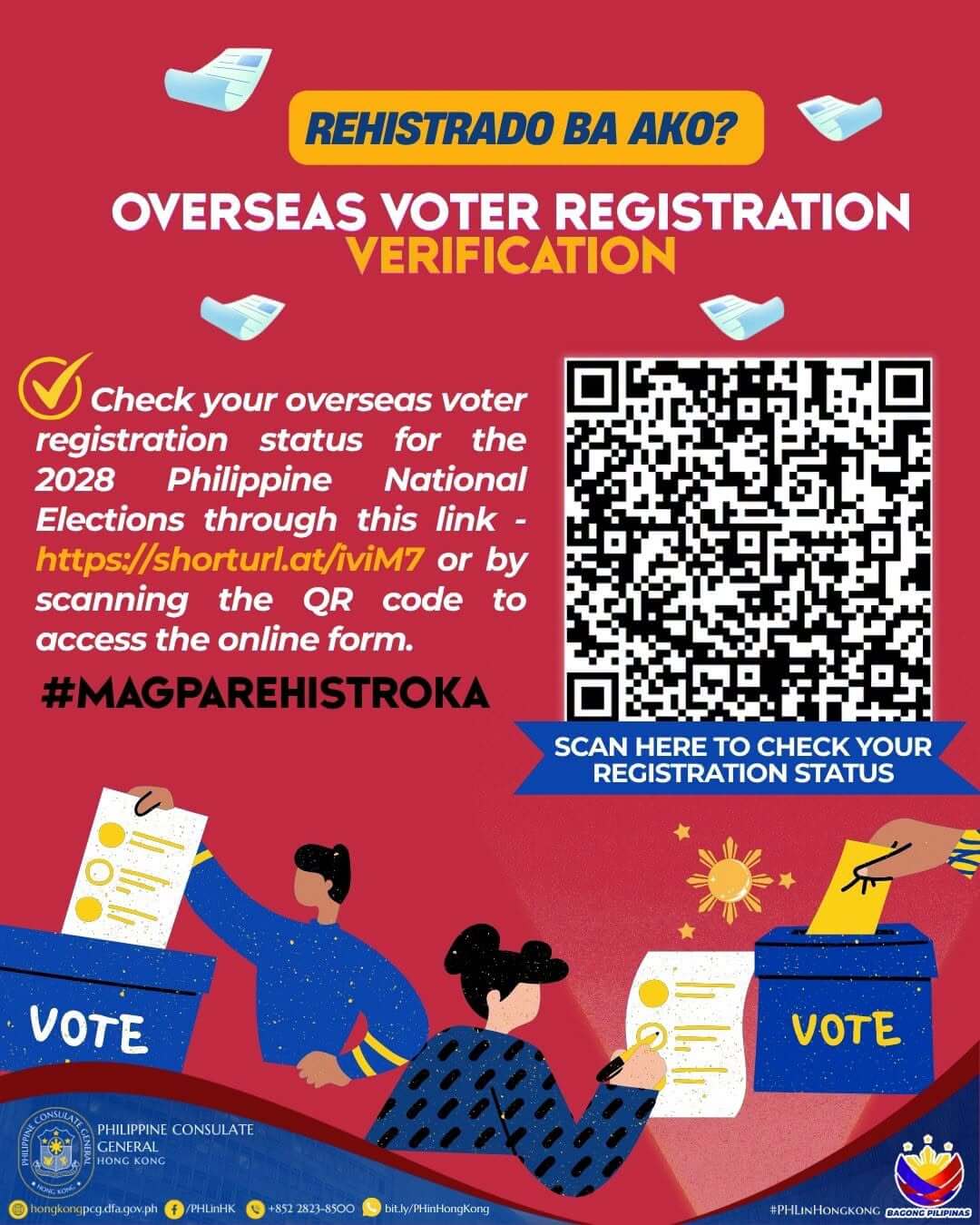
Check if you’ve registered as per latest update on the official FB page of PCG HongKong:

rehistrado ba ako for voting philippine consulate general hong kong

List of Registered Overseas Filipino Voters in Hong Kong

To participate in the national elections, first confirm your name is on the Certified List of Overseas Voters (CLOV), available on the Philippine Consulate-General’s website or in person.

As of now, no CLOV for the 2028 elections is available yet. We will keep you posted once this is updated!

Check back on the PCG website or this post for updates. For assistance, contact the consular staff directly.

Lists are ordered alphabetically. *Use CTRL + F to quickly find your name—make sure it’s typed correctly with no extra spaces.*

The lists are ordered alphabetically and are straightforward to use, and COMELEC officers may add information or notes as needed.

To quickly find your name, use the CTRL + F shortcut and double-check that your name is properly typed and that there are no additional spaces or characters in the field.

How to Find Your Name in the List of Absentee Voters in Hong Kong

To check if you’re eligible to vote in the upcoming COMELEC national elections as an overseas voter, follow these steps:

  1. Visit the PCG Hong Kong website and locate the List of Registered Overseas Voters, organized alphabetically by last name.
  2. Open the PDF file corresponding to the first letter of your last name.
  3. Search for your name. If it’s there, you’re eligible to vote.

How to Vote in Philippine Elections at the Philippine Consulate-General in Hong Kong

Step 1: Verify Your Eligibility

First, confirm that your name is listed on Hong Kong’s Certified List of Overseas Voters. This establishes that you’re permitted to vote.

Step 2: Provide Identification

Proceed to the Special Board of Election Inspectors (SBEI) and present an approved ID like your passport for identity verification.

Step 3: Acquire Your Ballot

Once confirmed, sign the electoral register and collect your voting ballot. Confirm it is in flawless condition—free from marks, tears, or smudges.

Step 4: Visit the Designated Voting Space

Move to the allocated voting area. The SBEI will supply a folder for ballot confidentiality and a pen for making selections, ensuring voting privacy.

Step 5: Diligently Complete the Ballot

Take ample time to fill out the ballot according to guidelines. Avoid making additional marks or errors.

Step 6: Thoughtfully Select Your Candidates

You’re allowed to vote for one President, one Vice President, up to twelve Senators, and one Party List. Overvoting is disallowed; choose with care.

Step 7: Hand in Your Ballot

Return to the SBEI and insert your completed ballot into the Vote Counting Machine (VCM).

Step 8: Stand By for Confirmation

Await as your voter’s receipt is generated. Refrain from removing it yourself; it acts as a record of your vote.

Step 9: Scrutinize Your Choices

Thoroughly examine your voter’s receipt to validate that all your selections are accurately recorded.

Step 10: Deposit the Receipt

If all is correct, place your voter’s receipt into the specified box for Voter’s Receipts. Note that taking photos or making copies is not permitted.

Step 11: Alert for Any Discrepancies

If you detect any inaccuracies, notify the SBEI without delay. Be aware; submitting false complaints is prohibited.

Step 12: Depart from Voting Venue

Excellent work! You’ve now successfully voted at the Philippine Embassy in Oman. Thank you for your active engagement in this vital democratic exercise.

Video: Overseas Voting Reminder: It’s Time to Cast Your Vote!

The Philippine Embassy in Hong Kong released an important announcement for all Filipinos in the Hong Kong about internet voting:

Contact Information of the Philippine Consulate-General in Hong Kong

Address: 14th Floor, United Centre Bldg. 95 Queensway Admiralty, Hong Kong
Telephone number: +852.2823.8501
Office Hours: Sunday to Thursday, 9:00 AM to 4:00 PM
Website: www.hongkongpcg.dfa.gov.ph
Facebook Page: https://www.facebook.com/PHLinHK

Google Map Location

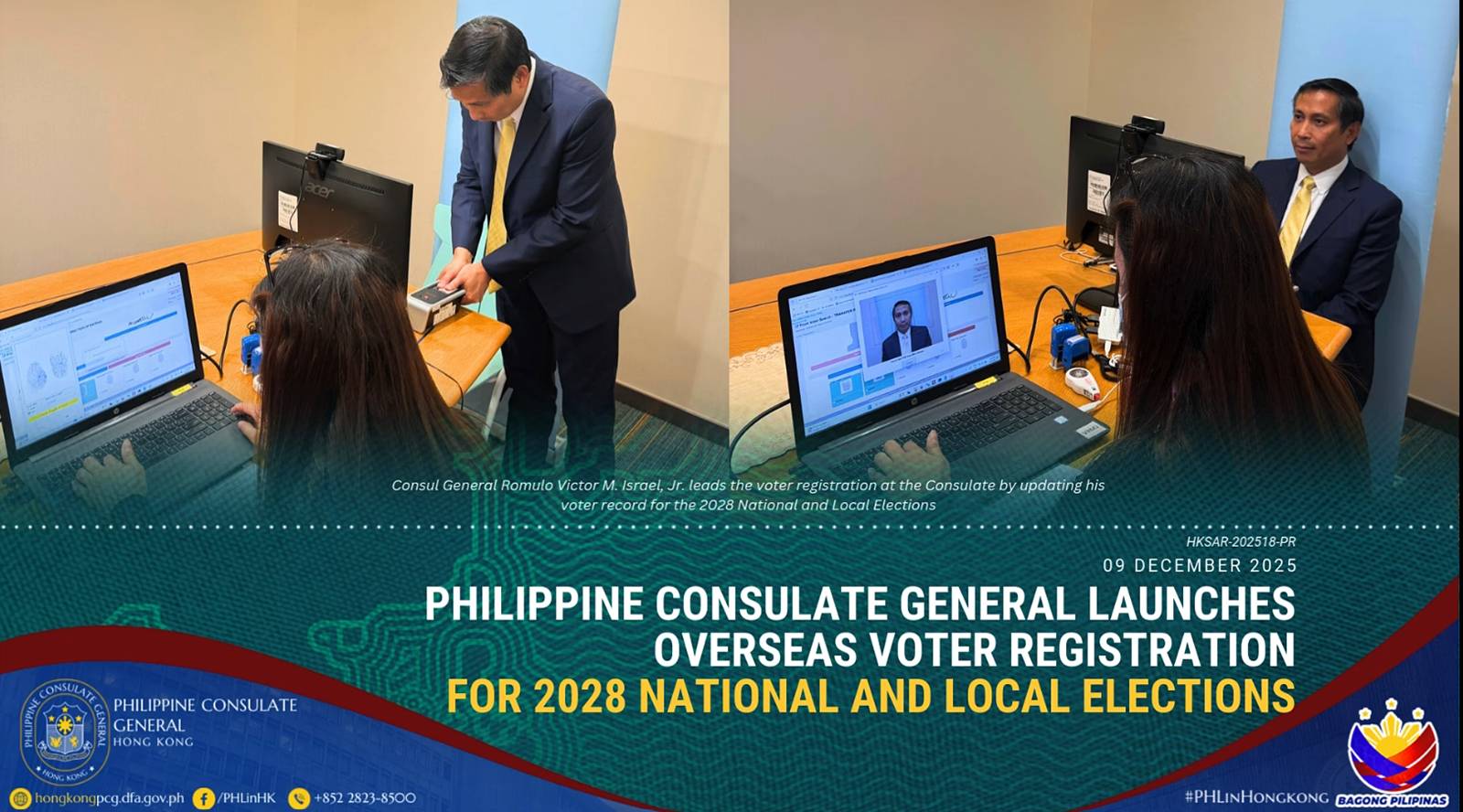
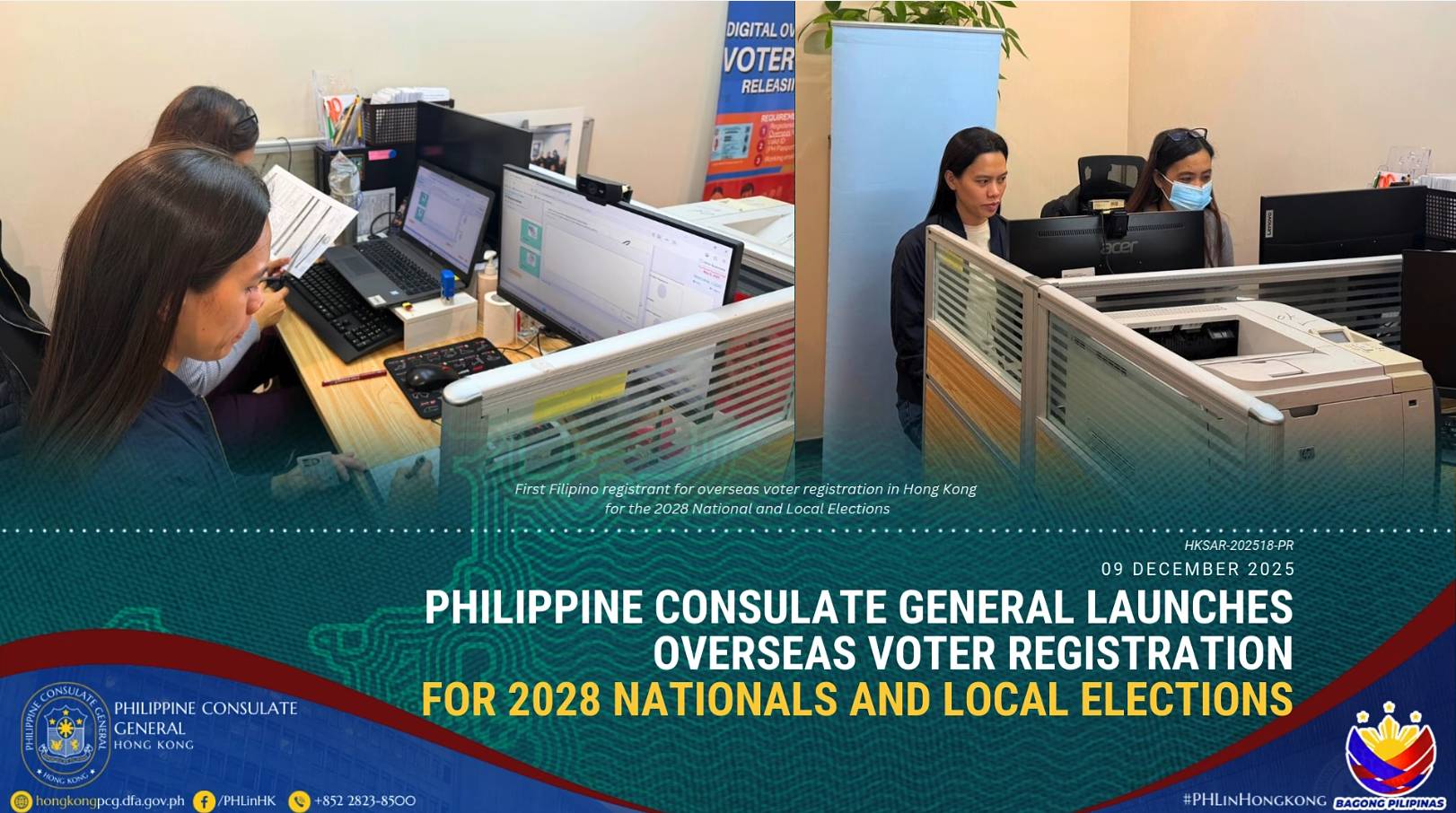
Overseas Voter Registration for Filipinos in Hong Kong

During the last Philippine national elections, OFWs in Hong Kong ranked fourth globally in terms of the number of voters. With a staggering 93,800+ registrations, it’s evident that the Filipino community in Hong Kong takes their civic duty seriously.

The Philippine Consulate General in Hong Kong reported the success of the Overseas Voting for the People’s Republic of China, encompassing not only Hong Kong but also votes from registered overseas voters in Beijing, Macau SAR, Guangzhou, Chongqing, and Xiamen.

If you are a Filipino based in HK, PCG HongKong has launched the online voting registration procedure. So if you have not yet registered as an overseas voter in Hong Kong, please note that registration is ongoing until 30 September 2027. Bring your original Philippine passport and proceed to the overseas voter registration counters on 18/F and 29/F, United Centre, Admiralty.

Note: If you have already registered, then check your name in the list of OFW voters in Hong Kong here. They will announce the official list a few months before the voting period.

Overseas Voter Registration for Filipinos in Hong Kong

philippine consulate hong kong launches online voter registration philippine elections 2028

To streamline and enhance the registration process, the Consulate has proactively promoted the use of the IREHISTRO platform for online overseas voting registration.

This user-friendly portal, endorsed by the Commission on Elections of the Philippines (COMELEC), provides eligible Filipino nationals in Hong Kong with a convenient and efficient means to register for the 2028 National Elections.

By actively encouraging the community to utilize the iRehistro portal, the Consulate aims to ensure that every eligible voter has the opportunity to participate in this vital democratic exercise, further reinforcing the community’s active participation in shaping the nation’s future.

Philippine National and Location Elections – May 8, 2028

The Philippine National and Local Election is set for May 8, 2028. This election will determine 12 senatorial seats, along with the President, Vice President, members of the House of Representatives, and local officials above the barangay level.

The winning senators will serve until June 30, 2034, joining the 2025 batch of senators — who will serve until June 30, 2031 — to form the 21st Congress of the Philippines.

Qualifications / Eligibility

  1. Citizenship: To vote, you must be a Filipino citizen, whether you were born as one or obtained citizenship through the legal process. This rule is important because it ensures that those who genuinely care about the Philippines’ future have the privilege to vote.
  2. Residency: Your current living situation is crucial. You must either be residing abroad or have definite plans to be abroad during the 30-day voting period, which runs from April 9 to May 8, 2028.
  3. Age: Make sure you’re old enough. You must be at least 18 years old on May 8, 2028, which is the election day. This ensures that only adults have the opportunity to be part of the voting population.
  4. Disqualifications: Check that you’re not disqualified according to Philippine laws on voting eligibility. Here are the reasons you might be disqualified:
    • Loss of Filipino Citizenship: If you lost your Filipino citizenship according to Philippine laws, you can’t vote. Be aware of your current citizenship status before attempting to vote.
    • Pledging Loyalty to Another Country: If you’ve publicly renounced your Filipino citizenship or sworn allegiance to another country (except if you have dual citizenship under Republic Act 9225), you can’t vote. However, if you have dual citizenship, you are allowed to vote.
    • Criminal Conviction: If you’ve been convicted of a crime that could result in at least one year of imprisonment, you are disqualified from voting. However, this disqualification can be lifted if you receive a full pardon or amnesty. If you fall into this category, you can start voting again five years after completing your sentence.
    • Declared as Insane or Incompetent: Any Filipino living abroad who has been previously declared insane or incompetent by a qualified authority in the Philippines or abroad, as confirmed by the Philippine Embassy, consulates, or Foreign Service offices, cannot vote. However, this disqualification can be reversed if the qualified authority later certifies that you are sane or competent.

By understanding these rules about who can and can’t vote, you can ensure that you meet all the requirements for participating in the May 2028 Philippine Senate Election.

Your vote is your way of influencing your homeland’s future, and every eligible Filipino living abroad plays an important role in this democratic process.

Requirements

  • Valid Passport: Make sure your Philippine passport is not expired. Prepare photocopies of the essential passport pages.
  • For Seafarers: Include a photocopy of your Seaman’s Book or proof of seafaring status along with your passport.
  • Dual Citizens: Submit your Dual Citizenship certificate or Order of Approval (original and copy) along with passport documents.
  • Personal Appearance: You’ll need to appear in person for biometric recording.
  • Complete the Voting Form: Fill out Overseas Voting Form 1 (OVF 1) on the COMELEC website. Already registered with complete biometric data? Use the OFOV’s Virtual Frontline Services (VFS) for specific applications.
  • Transfer of Registration: To transfer your registration to a Philippine Municipality, City, or District, apply at your intended voting area’s local Office of the Election Officer.

Follow these steps carefully to ensure your vote counts. Registering as an overseas voter is your chance to help shape the future of the Philippines.

How to Register at the Philippine Consulate General in Hong Kong

Step 1: Prepare Your Documents

Make sure you have the following ready before registering:

  • Valid Philippine Passport – your primary ID for registration.
  • Alternative documents if no passport:
    • Certificate from the Philippine Embassy/Consulate explaining your passport situation.
    • For those who reacquired Filipino citizenship under RA 9225: original or certified true copy of the Order of Approval or Identification Certificate.
    • Seafarers: photocopy of your Seafarer’s Book.

Step 2: Fill Out the OVF1 Form

Download the Overseas Voter Registration Form (OVF1) online or pick one up at your local registration center. Complete all fields carefully.

Step 3: Submit Your Application

Bring your completed OVF1 form and supporting documents to the designated registration center in person. Make sure everything is in order before submitting.

Step 4: Registration Period

The registration period for the May 2028 Philippine National and Local Election runs from December 3, 2025 to September 30, 2027. Register within this window to secure your right to vote.

Step 5: Verification and Approval

Authorities will review your submitted documents to confirm your eligibility. Once approved, you’ll receive official confirmation of your registration as an overseas voter.

Every vote counts — register on time and make your voice heard in the upcoming election!

how filipinos in hongkong can register online for voting in 2028 national and local elections

Video: PCG HKG Launch of 2028 National and Local Elections OFW Voters Registration

The video shows the announcement of the Consulate being ready to take registrations from OFWs based in this region.

Contact Information for the Philippine Consulate General in Hong Kong

Address: Philippine Consulate General Fourteenth Floor, United Centre 95 Queensway, Admiralty, Hong Kong
Telephone number: 2823 8500 (Switchboard)
Office hours: Sunday to Thursday, 9:00 AM to 4:00 PM
Website: https://hongkongpcg.dfa.gov.ph/
Facebook Page: https://www.facebook.com/PHLinHK

Google Map Location

error: Content is protected !!